Thursday, June 9, 2011

Sweden: Day II (Stockholm)

Saturday, June 4th:

            Today I slept in late as I did not get to sleep until the wee hours of the morning. My internal clock was still way off, but it did not matter as I was going to meet my girlfriend Jen at the Stockholm-Arlanda airport! I took the Arlanda Express (after wandering around T-Centraalen for a good half-hour) and met her at her terminal. We brought her stuff back onto the Arlanda Express and back to our hotel. Jen and I both agree that while our hotel was adequate, the room was pretty small and the hotel reminded us of a tiny cruise ship cruising through the hills of the Vanadislunden Park.

Storskyrkan - The Cathedral of Stockholm, from a nearby plaza:


            After Jen took a nap—long morning that resulted in a ridiculous experience at a Turkish airport—we decided to walk down to Gamla Stan (Old Town) to try to find some dinner. I also wanted to show Jen the sights down there, so we strolled around on the old skinny roads for a little while. We settled on an outdoor restaurant called Restaurang Kaffegillet right outside the main door to Storkyrkan, the Cathedral of Stockholm. It was a very cool location and our first taste of Swedish food, as I ordered a delicious Reindeer Roast with steamed vegetables and blackcurrant jam, and Jen enjoyed Broiled Herring served cold with baked potatoes and veggies. After our dinner we wandered around back to downtown Stockholm and stumbled upon another couple massive churches and a free festival with music run by Volvo in the Kungsträd Park. Inside this park we also snagged a local treat called a “lickrit” that was basically a massive melon-flavored sour straw.

Absolut Ice Bar Stockholm:


            Jen and I walked back to the hotel to get ready for our first night out in Stockholm. We had heard about the Stockholm Absolut Ice Bar, so we headed there for a late-night adventure. This bar is the first year-round icebar in the world. The bar is created entirely from ice—the walls, the bar, the seats, the glasses you drink from, are all made from ice by professional ice sculptors. The room is kept at -5 degrees Celsius (about 23 degrees Fahrenheit) all year, and visitors are required to wear a warm cape and gloves inside (trust me, you would want to anyways). As the bar is sponsored by Absolut Vodka, each of the ten or so drinks on the menu contain Absolut Vodka (and decent amounts of it for such a small serving ice-glass) and different fruit juices and sodas. We stayed at this bar until it closed—bars in Stockholm close at 1am—and walked back to the hotel for some sleep before a long day of sightseeing ahead. I should also note, it was still fairly light out when we walked home, and the birds were chirping as if it was morning.

Jen and I at the Original Absolut Ice Bar:


Wednesday, June 8, 2011

Sweden: Day I (Stockholm)

Friday, June 3rd:

Stockholm City Hall - or Stadshuset - Where the annual Nobel Banquet is held:


Hej!

           I arrived today at Stockholm’s Arlanda airport after a full night of flying through Reykjavik, Iceland. As the first stop on my big journey through Europe, I gathered my luggage and took the Arlanda Express train to downtown Stockholm so I could get to my hotel quickly and have a long nap to catch up on some sleep. My first impression of the city was wonderful—it is very clean, the architecture is stunning, and it reminds me a lot of my hometown of Boston! All of the people in Stockholm seem happy, are young and generally trendy, are all very good looking, and are very friendly to foreigners. It is clear that they learn English at a young age in schools, as nearly everyone I talked to had a good command of the language. The Swedish language, while it can sound super weird, is actually very close to English in structure and in some words. After a four day stay here, I picked up on a few words pretty easily just by seeing them a lot and hearing other people talking.
           Anyways, after a four-hour or so nap, I woke up at about 9pm and decided to walk around the city. I was staying at Vanadis Hotell & Bad, a family hostel, in a park north of the downtown area on Sveavägen. As I woke at 9pm, I expected it to be fairly dark however the sun does not set in the summer here until very late at night. Even when the sun set it never got truly dark, as it rose again at about 3am. I walked the twenty minute or so walk down to the Old Town, known as Gamla Stan. It is here that the buildings are the oldest, including the centuries-old churches, as well as the Royal Palace, built on the same plot of land as the original palace that burned down in 1697. This palace is also still in use, as the Swedish Royal Family use it throughout the year. I wandered around the old town, taking in the beautiful green oxidized copper spires and rooftops, before I lost track of time of how late it was. I had yet to have dinner, but each of the restaurants were now closing their kitchens!

Gamla Stan - or Old Town - of Stockholm:


           I found a fast-food-esque grill called Klaragrillen and ordered a Kebab wrap for my walk back up to the hotel through the main square called Sergels Torg. I wanted to try and sleep before Jen arrived the following day, as I knew we would do lots of sightseeing after she came from Istanbul. Also on the walk back, I noticed that there are a gang of sorts of young Swedes who slow-ride their vintage Cadillacs up and down Sveavägen all night, blaring punk and American rock music while yelling at people out of their windows. They seemed hostile at first, but after experiencing them a lot and seeing the reactions of folks on the sidewalks, I believe they are just as tame as everyone else. I only wish they could have turned their music down at night, as the bass, combined with jet-lag, kept me up basically until the sun rose.

Tuesday, June 7, 2011

Blog Posts Coming

Hey All,

I haven't really had any internet in Sweden, except at the Airport here, so I will post when I have some time soon! Hopefully with pictures as well :)

-Rog

Saturday, April 9, 2011

Turkey Photos

Hello All,

As I could obviously not include all of my photos from Turkey into the blog posts, here is a link to my Picasa Web Account with an album of all ~550 of them on there. Enjoy!

Friday, April 8, 2011

Turkey: Day IX (Istanbul)

Sunday, March 27th:

Hagia Sophia, At Night:


            My last day in Turkey! Such a sad revelation after such a wonderful and amazing adventure! We woke up early to catch our flight back to Istanbul which had been moved up an hour due to the rest of Europe going on daylight savings and Turkey deciding to wait an extra day—weird. Anyways, we got back to Istanbul around 2pm and checked-in to our new hotel, the Polat Renaissance near the airport. I would like to thank my father, Dana, here as he hooked us up with a room on the club level that overlooked the whole harbor of the city. We got settled in and decided to go to try and see the famous Whirling Dervishes (or Mevlevi Dancers) perform their Sema ceremony. After waiting over an hour for the bus to come by the suburban neighborhood of our hotel, we instead decided to head straight to Sultanahmet where I had scoped out a restaurant to finally taste the Testı Kebap dish. We wandered around the area behind the Blue Mosque before finally finding the Aloran Café and Restaurant, which we ended up having completely to ourselves. Do not be fooled by that information, however, as this was my favorite meal and meal experience of the whole trip.
At Aloran we had a wonderful waiter named Yunis who spoke English with us the whole evening. The Testı Kebap dish that I ordered is very unique but amazing—again props to my brother, Brad, here as he recommended that I not leave the country without trying it. The dish is lamb, onions, sweet peppers, and mushrooms cooked in a mushroom sauce. The special part, however, is how it is cooked. The mixture is cooked in a ceramic pot in a fire, sealed at the top with dough. The air inside builds up, and the server smashes the pot before handing you your meal. How awesome is that! My dinner was phenomenal, and Jen also had a very yummy Swordfish Kebap that we both enjoyed with a delicious bottle of Kalecik Karasi, a Turkish red wine. Yunis chatted with us for a while after dinner, offering us Turkish Delights and Turkish tea for free before sending us on our way.

Dancing with the Workers at Şiva:


After dinner we walked around the corner to a bar called Şiva I had noticed earlier which offers both Nargile and beer, and even more importantly, beer other than Efes! I ordered myself a Carlsberg and an orange Nargile while Jen ordered a cocktail of her own. This bar was the most fun place, I think, we went to during the whole trip. The bar was owned and operated by four or five best-friends, all from Kurdistan and all in their mid-twenties. We chatted with the bartender, Gino, and two of his friends, Fico and Hasan, for hours. The men even threw on some traditional Turkish music and began dancing for us. Before long, Jen and I were both recruited to come dance with them, and we laughed the night away until heading home around 230am. What a long night, and what a trip! Unfortunately, my flight the following morning is early and I will lose an hour of sleep tonight due to daylight savings, but I can sleep on the plane. My only regrets are not getting to taste golden Kokoreç (Lamb Intestines), more of the desserts, and the Turkish waffles that Jen says are so delicious. I will miss Jen a lot, however the next time I see her will be in Prague after I have graduated! This trip has been one of the best trips of my life, spent in great company, and I would recommend Turkey as a vacation spot, cultural experience, and historical expedition to anyone!

Elveda Istanbul!

Turkey: Day IIX (Izmir and Ephesus)

Saturday, March 26th:

Ephesus, Turkey:


             I may sound like a broken record by now, but this trip has managed to completely blow me away with each passing day. Today we woke up at around 8:00am to eat a quick breakfast at the hotel and meet our tour group to travel to the ancient city of Ephesus in nearby Selçuk for the day. We were greeted at 9:00am by our guide, Tayfun, from Bravo Tourizm. To our surprise, nobody else had signed up for the tour for that day, so we had a private tour all day! The drive to Ephesus is about one hour southward from Izmir, which Jen and I used to catch up on some more rest before we got closer and our guide began telling us facts about the city and the day ahead. He explained (in very good English for a Turkish man) how Ephesus had been inhabited for thousands of years and began to rise as an Ancient Greek city until its summit as the second largest city of the Roman Empire. He also explained how the city had been moved three separate times to accommodate the changing landscape, particular the moving shores of the harbor that offered it one of the biggest seaports in ancient times. Our first stop on our day’s journey was the House of the Virgin Mary.

Statue of the Virgin Mary Outside of Her Home in Ephesus, Turkey:


            Tayfun explained to us that upon his death, Jesus put his mother’s protection in the hands of St. John the Evangelist. St. John was a resident of Ephesus, so presumably he brought Mary with him back to his hometown to watch over her and protect her. For centuries this was mere speculation and her home was never discovered, however people had hope of discovering it. In the nineteenth century, a German nun had an apparition that she saw the house of the Virgin Mary on top of a mountain, next to a spring, overlooking the bay. The house was soon discovered in the late nineteenth century and is now a site of religious pilgrimage. The home, now restored, has been visited by Pope John VI, Pope John Paul II, and Pope Benedict XVI. We arrived at the house and immediately recognized the severe tranquility of the area. Nobody was saying a word, aside from quiet prayer. The home is extraordinarily humble, but merely walking around it one is filled with a sense of awe and wonder. Visitors are also allowed to wash their hands and drink from the spring adjacent to the house. Both Jen and I were amazed at this site and we both purchased small glass bottles of the “holy spring water” before heading back down the mountain to the ruins of Ephesus at its base.

Ancient Carving of the God Hermes / Mercury:


We walked into the north gates of Ephesus with our guide and were immediately greeted with massive stacks of marble ruins. Immediately inside the gate our guide led us around the first area of ruins, explaining the terracotta piping that the inhabitants used for irrigation, and also showing us an ancient form of a backgammon board, carved into marble, that was found near the politician meeting place. He also showed us a small carving on the ground of a circle surrounding a cross-like shape that was used to show other Christians that Christians were secretly practicing there. Pretty tricky way to hide during times of difficulty for the early Christians! We walked down the first main marble avenue of Ephesus and entered the first prominent building of the city, the Odeon. The Odeon looks, at first glance, like a small Roman theatre, except it is older and housed politicians, not gladiators and actors. Greek and Roman politicians debated in the semi-circular chamber for centuries. Continuing down the road we passed a place in the marble where five holes were dug into the stone. Tayfun explained to us that the eternal flame of Ephesus was chained to the ground there so ships could see the city from the harbor. It is also a symbol of good fortune, and is positioned next to a stone carving of the both Hermes (or the Roman Mercury) and his symbol.

The Temple of Hadrian:


We walked to the bottom of the hill and came to an intersection where stood a massive tomb and another walkway leading to the ruins of the Temple of Domitian. At the base of the hill also stood a carving of Nike (or the Roman Victoria), a symbol of victory for those who lived during these times. We turned the corner and immediately laid eyes upon hoards of more massive ruins. It was astonishing to imagine all of these buildings so many centuries ago, filled with merchants, slaves, and city dwellers living their lives. We walked down the next marble road through the Hercules Gates and along a row of old merchant storefronts. Each little store decorated its front steps with its own mosaic designs, and these are beautifully preserved today. Across from the storefronts is the massive arching facade of the Temple of Hadrian with carvings of Hadrian and Medusa among the friezes on its top level. Let me pause here and note that I do not mean to underestimate the sheer beauty and awesomeness of these buildings by simply listing their names—you really have to see them for yourself! There are just so many of them it is almost overwhelming and awe-inspiring.

The Roman Terrace Houses:


Farther down the road we entered the Latrine where people would pay to use public toilets. Our guide also explained to us that slaves used to heat the marble seats in the winter by sitting on them until a patron came along to use them. Also just outside of the latrine was the first carving of Artemis, the main god to whom the city dwellers prayed. Across from the Latrine is an entrance to a sub-museum of Ephesus, the Roman Terrace Houses. Visitors pay a small entry fee and enter an on-going excavation of Upper-Class Roman Homes ascending the hills that surround Ephesus. The whole building is covered by a massive roof to protect those working inside, and a glass walkway has been installed so visitors may observe the houses. These houses are absolutely top-notch. Archeologists have pieced together thousands of pieces of marble to try and reassemble the walls of the homes, and many of the walls are covered in layers upon layers of fresco paintings. The houses featured frescoes of cupids, the muses, Medusa, Plato, Socrates, and others. Scores of mosaics also decorated the floors and walls of these rich dwellings. The back exit at the top of the terrace offered visitors the beautiful view of the harbor and the rest of Ephesus that these rich families enjoyed every day.

The Library of Celsus and the Gate of Augustus:


Exiting the Terrace Houses Museum, one is immediately confronted with the largest building in Ephesus, the great Library of Celsus. This library was reconstructed from ruins in the 1970s, and in its time was the second largest library in the world, second to only the great library at Alexandria. The massive facade of the library is what anyone would see 99% of the time if they Google-searched Ephesus. Before going inside the library, Jen and I were mobbed by a group of young Turkish schoolchildren who all wanted to get a picture taken of them with the American tourists we were! This gave me quite a laugh. Inside the library is the tomb of Celsus, an Ancient Greek Governor of the Asian provinces of the Greek Empire. Immediately adjacent to the library is the Gate of Augustus which leads to the massive commercial Agora of Ephesus. Most of the Agora is in ruins, however visitors can clearly see its massive footprint, and some small goods have been recovered and are on display in cases nearby. Across the street from the library, as our guide noted, is the Brothel of Ephesus—more on that in just a moment.
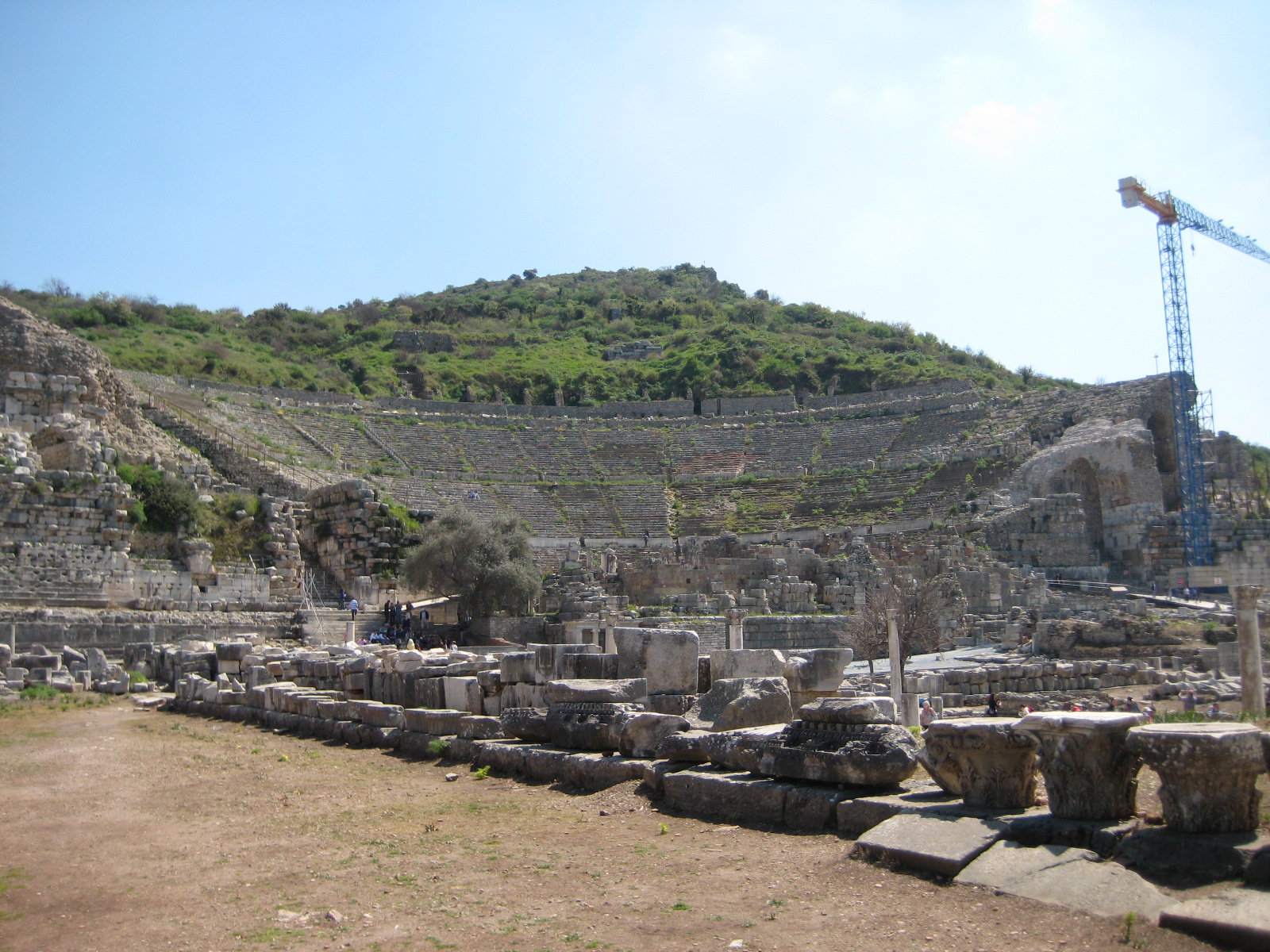
We continued down another main street of the city, passing more massive marble ruins and Ancient Greek inscription with each step. We got to one carving and stopped. Our guide explained that it was an ancient form of advertising. The left foot carving told people that this building was on the left side of the street. There is a beautiful woman pictured, signifying the Brothel. Also carved into the stone is a heart, filled with coins, explaining that these ladies can offer love but for a price. Pretty cool seeing as I’d love to be involved in advertising in the coming years! We passed more carvings of gladiators as we approached the Great Theatre of Ephesus. In its time, this theatre could hold more than 44,000 people. As we entered, the tour guide of a Japanese tour group was giving a performance, singing a song in Ancient Greek. The sheer magnitude of this theatre can almost not be appreciated from up close—it may have been the largest one in all of the Greek or Roman Empires.

The Great Theatre of Ephesus:


            Across from the theatre are the ruins of the Gymnasium where gladiators would practice in the nude. The ruins are adorned with symbols of the gladiators and victory: wolves, bulls, rams, goats, and lions. We walked through these ruins and headed out the South gate of Ephesus to continue our tour to other locations for the day. As we had some extra time, our tour guide decided to show us more of the Turkish culture by taking us to some cooperatives in the area. Our first stop was at the Ephesus Ceramics Production Center where we were shown how pottery is made, painted, colored, decorated, and cooked in a kiln to harden. We were then brought into their showroom where I finally found a Hittite Wine Jug that I had been looking for the whole trip! These jugs look like they have a massive doughnut in the middle of them that users put their arms through to pour the wine. After some haggling I made off with the jug for 300TL.
            Our guide then took us to a production center called “Galata” where we had a lavish feast for lunch. It seemed like each course was a meal in its own! We ate fairly quickly before walking to a Turkish silk rug factory. In here we were shown how the silk is taken from the cocoons of silk worms and woven on a machine. Then we were shown how the workers weave each and every knot of the rug, often taking over a year to make a complete one! The whole process amazed me, but it could not tempt the college kid that I am to spend over 2500TL on a silk rug, even after a cup of free Turkish coffee. Next door was a jewelry store where we got to see how diamonds are cut and set on jewelry. Another cool thing that they do at Turkish jewelry stores is a gold style called “Fibula.” This style consists of wrapping eighteen karat gold with twenty-four karat gold and the finish product has a dull sort of luster to it that resembles the great Ottoman treasures. Our next stop was at a leather factory called “Naturel” where we were given our very own personal fashion show! As Turkey is a Muslim nation, most of the people in the country do not eat Pork as it is against Islam practices. Therefore, the people eat a ton of Lamb. These lamb hides are then donated to the state to create ultra-high quality leather sold at outlets like these. The best part of the fashion show was that Jen was recruited to show off one of the jackets herself! We did not buy anything here, and after a quick stop at a Turkish treat store where I purchased some Turkish Delights to bring home to friends, we were back on the sightseeing trail.

St. John's Basilica:


            Our Ephesus ruins tour picked up again at St. John’s Basilica. This church was constructed in the sixth century and housed the tomb and bones of John the Apostle before his body was looted by Crusaders. The church stands in remarkable condition atop a hill in Selçuk below a more modern Ottoman fort. We walked around the premises of the Basilica before heading down the hill to the Isa Bey Mosque constructed in the fourteenth century. The visit inside the mosque was quick as it was almost prayer time, however we walked around the courtyard outside filled with Ottoman tombstones and Ancient Greek columns. Tayfun explained how most of the columns for both the mosque and the basilica above were “recycled” from the Temple of Artemis, our next stop. We drove farther down the hill to the site of the Temple of Artemis. Here stands only one remaining column of the over one-hundred that were built in the fifth-century BC. This temple was once one of the seven wonders of the ancient world. Walking around this plot of land, I was filled with an eerie sense of wonder and awe as such a remarkable structure had both been built, revered, and destroyed on that very ground. This was our last stop of the wonderful tour, and this feeling stayed with me for the whole car ride back to Izmir. It also seemed to spark an extreme desire to learn more about Ancient History. Furthermore, Tayfun explained to me that twenty-two separate civilizations had come through Anatolia (Asia-Minor) over the course of human history. Absolutely stunning.

The Temple of Artemis:


            We were dropped off by our tour van at the hotel and decided to catch a couple sites of Izmir before the sun went down as we were leaving the following day. We walked around the town to the ongoing excavation of the Agora of Smyrna and to the Izmir clock tower at the waterfront. We watched a beautiful sunset before walking through the Konak Pier, a mall right on the waterfront, and heading back for a quick nap before dinner. On our way back I also got to try Ayran, which is basically a drink of yogurt and water that tastes like salty milk—not necessarily for me. Unfortunately, we had requested that a dinner reservation be made at a place I had heard about, but the hotel reception mixed up our wishes. We got a taxi all the way (and 38TL) to the restaurant outside of the city before walking inside and learning that it was closed for a wedding, so we had to find our way (and 20+TL) back to another restaurant. We settled on a wonderful place called Boğaziçi Restaurant right on the water where I ate some fried calamari, Seabream, and drank a nice Turkish Chardonnay. The fish was delicious, and I should remind people that when you order balik at Turkish restaurants, it usually comes out to you with bones, scales, eyes, and all! Though, if it is a nice establishment, they will usually offer to clean the fish for you. We headed back to our hotel after dinner to get some sleep after such a long day—this day was by far the most packed of the trip, however the sites we saw were truly remarkable and once-in-a-lifetime opportunities. That being said, I would return in an instant.


The Izmir Sunset:


Thursday, April 7, 2011

Turkey: Day VII (Izmir, Pamukkale, and Hierapolis)

Friday, March 25th:

Pamukkale Travertines:


            I feel like each day we have a stranger but more awesome adventure. Today we woke up for the hotel buffet breakfast of Börek, Turkish Delight, peach nectar, assorted meat, cheese, and bread, before heading off to the Pamukkale Travel companies desk to purchase a bus ticket to Denizli. I should note that I also got to try a Middle Eastern delight at breakfast known as Helva, a very melt-in-your-mouth sugary treat that is made differently in every nation in the region. Denizli is the capital of a province to the east of Izmir, and is about a three and a half hour bus ride from Izmir. We had some difficulty, again with the language barrier, trying to get onto the correct bus, but we made it and both got some well needed rest on the bus. Another note that Jen and I were laughing at, Turkish bus services are like airline services around the world. Instead of a flight attended, the busses have an attendant of its own who serves drinks and food through the bus during your ride. It is a pretty cool idea that I enjoyed a lot! We had some difficulty trying to figure out which stop was ours, and as the bus travelled the 250 or so kilometers to Denizli, our surroundings became more and more Middle-Eastern. The mountains also got taller, until snow-capped peaks of over 10,000 feet came into view in the distance. We were taking this bus to Denizli to go to the World Heritage Site of Pamukkale and Hierapolis, an ancient Roman city built on the top of a beautiful natural site of calcium deposits in travertine shapes down the cliffs.

The White Soils of Pamukkale, Turkey:


            We finally got to Denizli and found a shuttle for the 45 minute ride up to Pamukkale. The city of Denizli seemed very Middle-Eastern and all over the place, as the roads were very hectic and the buildings were very rustic. A man named Mustafa spoke very good English and helped us find our way while offering us a restaurant recommendation that we would use later in the town of Pamukkale. We got off the bus and figured out that busses ran all hours of the night back to Izmir, which really calmed my nerves and let me enjoy the rest of the day. On our walk up the hill to the World Heritage Site, we also randomly ran into the Turkish Army, or Jandarma, working on something in the town. It was definitely super random to run into a group of men carrying submachine guns in such a remote town, but we just walked by and it was no big deal.
            Walking up to Pamukkale, one can immediately notice that the ground is a very bright white color. A high level of calcium in the hot spring water that runs down the mountains has caused the ground to turn bright white. It almost looks like snow on the ground, which is not so far-fetched as there is snow on the high peaks that look down on you. It is also these calcium deposits that hardened over time and formed the travertines that cascade down the cliffs. As we walked up, we reached the steam of water running down the hill, and were required to remove our shoes to not hurt the hardening sediment as we walked upon it (and to not slip on the slippery, wet slope). It is a very cool natural feature, and the water feels very warm on your feet as you walk up. The park management has created some artificial travertine pools that visitors are allowed to walk in and bask in the sun and the warm spring water.

A Roman Statue of Neptune:


            At the top of the calcium-stained cliffs, visitors are greeted with a vastly different sight. In stark contrast to the natural creation below stand the ruins of the ancient Roman city of Hierapolis. We walked around some of the ruins which have stood scattered since a series of earthquakes centuries ago. We walked into a sub-museum of the park, the museum of small artifacts, which is built inside large Roman bath buildings that still stand. Inside are tons of ancient coins, pots, tools, and sculptures to the gods. There is also a collection of friezes to the gods and sarcophagi inside in very good condition, alongside a series of tombstones of gladiators and prominent figures of their time.

The Theatre of Hierapolis:


            We continued up the hills towards the massive Roman Theatre. A symbol of ancient Roman cities, the theater is the largest structure still standing and the park management have been restoring the stage facade for years. It is a beautiful building and offers great views of the entire city and mountains surrounding the visitor. We climbed the hill even farther to discover the Martyrion of St. Phillip, or the location where St. Phillip was martyred. These ruins are absolutely stunning to walk around, and very humbling that our own human race was so advanced so long ago. We continued back down the hill to the park center, a series of restaurants and shops built on the location of an old roman bath. The park management has restored much of the bath and routed the hot spring water into it, offering a modern roman bath pool for visitors to swim in for a (slightly steep) fee of 25TL. Also very cool, an earthquake in the 14th century knocked Roman columns into the pool, and swimmers walk all over them and swim in the pool with them. It seems slightly gimmicky at first, but you cannot help but feel like you are back in Ancient Rome as you swim around the hot pool.

Frontinus Street of Hierapolis, Turkey:


            After snagging a quick tea, Jen and I made our way across the other half of the city. This portion of the city holds hundreds of ancient tombs, including many built right into the white soil which again offers an interesting juxtaposition of man and nature. Also in this direction are the ruins of the old Agora, or the marketplace in Roman times, as well as massive arches of a basilica. Visitors can walk directly down the colonnaded Frontinus Street, the main avenue of the city, and see ruins of a very well preserved latrine and various other buildings. At the end of Frontinus Street is the massive Necropolis of Hierapolis, one of the largest in all of the Ancient Roman Empire. As we discovered later, the reason for this old cemetery being so large, is that Romans wanted to be buried near Saints, and St. Phillip is buried in the city. Our walk back down to the town of Pamukkale was breathtaking as we enjoyed glimpses of the sun setting over the distant mountains and casting its orange and pink sky reflections on the pretty blue waters falling down the mountain.

A Roman Tomb Set Into the White Soil of Pamukkale:


            Back in town, Jen and I got our bus tickets sorted out and found that the last regularly scheduled bus home was at 9:30pm, so we sat down at a wonderful restaurant called Mustafa at the Mustafa Hostel. It was recommended to us by the bus attended that had helped us get up to Pamukkale in the first place, and it was a very cozy little setting with comfortable seats filled with pillows to sit on. We chatted with locals and a nice Czech traveler while watching the Turkish U-18 Football Team demolish Liechtenstein by a score of 6-1. I ate some lentil soup along with a dish called the Pamukkale Kebap, which was a chicken kebap dish that was broiled along with peppers, tomatoes, onions, and garlic and was served on a hot plate with the fire that had cooked it still blazing underneath. It was a great presentation, and an even better meal! We headed back down to the bus station to catch our bus and made it just in time. The bus seemed to take a while, and unlike Jen, I was not tired at all so I stayed awake on the ride and listened to whatever English music they had. Each bus seat had a monitor with some movies, TV shows, and music on it, however just about all they had for English music was the Ace of Bass Greatest Hits album—shoot me now. The bus got back to Izmir around 12:30am and after some trouble finding our free shuttle back to Basmane, we finally got home and crashed before another early morning and full day of touring. Phew!


Pamukkale, Turkey at Night: