Tuesday, July 5, 2011

Denmark: Day IV (Copenhagen)

Friday, June 10th:

Christiansborg Palace:


            Our last full day in Copenhagen was a fun one and a beautiful day! We again went to a Koffe café, this time called Makkekafe, for breakfast, again scooping a croissant and some tea before heading to Christiansborg Slot (Palace). Christiansborg Palace was the site of six different castles that were destroyed, renovated, or burned down before the current one was built in 1928. The first of these castles was built in 1167 by Copenhagen’s founder, Bishop Absalon. This building is particularly unique in that is houses all of Denmark’s Legislative, Executive, and Judicial branches under one roof—one of the only buildings of its kind in the world. It is also used as a reception hall and gala venue for events held by the Queen of Denmark.
            Tourists can purchase a three-part ticket that allows them to visit the Royal Reception Rooms, the Ruins Museum under the Palace, and the Royal Stables. I should note that the Royal Stables have weird, weekend-only hours and we did not make it to see them, and also that the Parliament is available for tours if called ahead for. No photos are allowed inside the palace, per request of the queen. The first stop we made was the Royal Reception Rooms, which were absolutely magnificent. My favorite of the entire palace was a massive hall in which hang a couple dozen tapestries, made in 2000 by a Danish artist, depicting major episodes and events in the history of Denmark in a very modern style with bright colors. It was spectacular enough to prompt me to purchase postcards of all the tapestries so I could look at them more at a later time and to admire them. After going inside the palace, we went underneath it to the Ruins museum to see ruins of the old circular wall surrounding Bishop Absalon’s palace dating back to the 12th century. There were also other ruins of the old palaces, including the famous Blue Tower that served as a prison inside the palace for over a century.

The Old Stock Exchange Building of Copenhagen:


            We continued our day by walking towards the Christianshavn district, walking past the beautiful Old Stock Exchange building. We crossed the canal bridge and stopped to finally indulge ourselves with some Danish pastries! We stopped at a bakery called Lagkaghuset, again recommended to me by my friend Matt Collins. We purchased three items at this bakery, and each was delicious! First we tried a Christianshavnerkage, a little nutty cake with cream frosting on top. Second we tried a Hindbærbronbærkage, another little cake but this time more crunchy and covered in berries on top. Finally, we tried a Hindbærsnitte, which is basically a Strawberry Poptart but with real frosting and real jelly inside. All three were equally decadent, and I realized that if I lived there I would be a very large person.

Vor Frelsers Kirke (Our Savior's Church):


            We walked from the bakery next a short way to my favorite non-palace building of the trip so far, the beautiful Vor Frelsers Kirke (Our Savior’s Church). What makes this church so stunning is its sheer beauty both inside and out. Outside, on the top of the church, is a snail-shell shaped spire ramp leading up a gold and purple spire. At the very top is a modern statue of Christ, holding a flag, and standing on the globe in bright gold. Inside the church is a massive baroque wooden organ façade that dates back to 1660. Now that is what I am talking about! Furthermore, tourists are allowed to purchase a ticket to climb up the spiral ramp, or taarn, of the spire! Jen and I went up to the top and looked over Copenhagen on a particularly windy (which made it slightly frightening) but beautiful day. The ascent to the spire itself is really cool as you climb a series of super steep and old wooden stair sets through the bells and clock-workings of the tower. You can also see the Swedish coastal city of Malmö on the other side of the sound, and the largest car/rail bridge in Europe connecting the two countries.

The Baroque Organ Inside Vor Frelsers Kirke:


            After visiting the church we walked again the short distance to Christiania, the freetown society that we had visited two nights prior. It is much less creepy and sort of charming during the day. Pusher Street is still very weird and sometimes sketchy, with its “soft-drug” booths, but the rest of the town can be peaceful and pleasant, however there is always the faint aroma of marijuana in the air as youths and adults alike flock to “legally” indulge. We found our way through the parks to a restaurant in the back of Christiania called Morgenstedet, which means “good” or “pleasant morning.” It is a vegetarian restaurant, and I had a cheese and pasta lasagna with carrot and apple salad with almonds and radish in it. Jen ate rice and steamed broccoli with a tofu and mushroom teriyaki sauce, and both lunches were very tasty. We walked around Christiania some more, taking in the weirdness of the place and the bustling nature at the big café and concert area called Nemoland before heading back to the hostel.

The Gate to Christiania, Front and Back:


            We hung out at the hostel for a brief time before heading back out to dinner at a restaurant called Café Sari where I had a House Casserole of sausage, beef, chicken, mushrooms, and peppers. Jen ate some baked salmon and pasta with cream sauce. We were planning on going to the Tivoli Gardens that night for a brief visit before they closed at 1am, but the dinner ended up taking far longer than we thought, so we went back to the hostel for a few games of Foosball and a couple beers before finally getting to bed around 2am. Tomorrow morning we would have to wake up at about 5:30am to make our flight to Prague. All-in-all, Copenhagen is a wonderful and lively city. I will return to Scandinavia in the future (and to Iceland later in my trip), however I hope that some of the prices come down as the countries as a whole are all very expensive, but fun nonetheless. Farvel Danmark!

Saturday, June 25, 2011

Denmark: Day III (Copenhagen)

Thursday, June 9th:

Inside the Ny Carlsberg Glyptotek Museum:


            Rain today. We woke up to some rain so we decided to sleep in and to wake and explore the things close to our hostel. We stopped at a local Koffe (Coffee) café to grab a fruit smoothie and a croissant before heading to the Ny Carlsberg Glyptotek museum of art. Inside this museum were massive collections of ancient Mediterranean art, Ancient Egyptian art, French sculpture art, and tons of Danish and French paintings. Jen’s favorite was an exhibition of female bronze sculptures made by Degas, while mine was the Egyptian Art and the French Impressionist paintings of Toulouse-Latrec, Gaugain, and Manet (including a personal favorite painting, “The Absinthe Drinker”). We spent well over three hours in this massive museum before leaving as the rain had subsided!

Manet's The Absinthe Drinker:


            Before grabbing lunch we made our way inside the Sankt Petri Kirke (St. Peter’s Church) as it was closed the previous day. It is (I think) the oldest church in the city, and very basic but pretty inside. We walked some more over to the shopping district of the downtown area and ate lunch at a little bagel shop called The Bagel Company. I had a smoked salmon bagel that was particularly tasty. We did a little shopping afterwards and walked into the church inside the Rundetårn, also known as the Round Tower. Inside the church was perhaps the most ornate organ façade I had ever seen, and someone was playing it to boot! We explored the magnificent church before going up to the top of the Round Tower for some views of the city. This tower used to house a library and still holds an observatory that was used by Tycho Brahe for his astronomical observations that led to some of our currently accepted theories.

View from the top of the Rundetårn (Round Tower) of Helligaand's Kirke and Christiansborg Palace:


            As the weather had subsided for the day, Jen and I decided to do as the Copenhageners do and to get some bikes to ride around the city. It is estimated that half of the 1.5 million or so people who live in the city use bikes as their main method of transportation, and it is very efficient! Copenhagen also has a bike system called “City Bikes” with which you can slip in a 20 DKK coin into the right kind of bike, ride it around, and return it to a similar City Bikes stall and get your coin back; free bikes! We rode our (rickety) bikes first to the district of Nørrebro to the park where the Assistens Cemetery is. Inside this cemetery are the graves of great Danish minds such as Niels Bohr, Hans Christian Andersen, and Søren Kierkegaard, all of which we viewed. Since we had the bikes, we decided to reach parts of the city that were difficult to walk to from our hotel, so we headed to the northern-most part of the downtown area to see the Little Mermaid Statue (Den Lille Havfrue).

The Little Mermaid (Den Lille Havfrue):


            We rode way up to see this site, which is surprisingly super small given the tourist attention it gets. The statue is just a few meters off of the shore, and it resides here because Hans Christian Andersen, a Danish writer, wrote the Little Mermaid story. Next we rode down to the Gefion Fountain, Copenhagen’s version of the famous fountain in Rome. Immediately adjacent to the fountain is a beautiful church called Sankt Albans Church, and a peculiar area called the Kastellet, also known as Copenhagen Citadel. This area is surrounded by old fort ramparts and is open as a public park now. We walked around inside, wondering what the buildings were used for now that the military had moved out, and decided it was time for dinner. We made our way back down to the Nyhavn area near the docks and had a dockside outdoor dinner of King Crab legs with a bottle of Chardonnay at a restaurant called Nyhavn 37. We also enjoyed a Gazpacho appetizer and had a traditional Danish dessert called Rødgrød med Fløde which was mostly ground up berries with crème. Very delicious! After dinner we stayed and watched a brief bit of a free dockside Danish concert before heading back for a beer and some early rest. I think the bikes took a lot out of us, especially for me—my bike was so old and struggled to move that I had to peddle very strenuously just to get it moving!


The Sankt Albans Church near the Kastellet:


Friday, June 24, 2011

Denmark: Day II (Copenhagen)

Wednesday, June 8th:

Amalienborg Palace:


            An exhausting but wonderful day today—Copenhagen is much bigger than Stockholm! We started our day by eating the breakfast buffet at our hostel, which was mostly the same as in Stockholm: cereal, yogurt, granola, veggies, but now with some brie and more cheeses and tasty bread. We had heard it was going to rain on Thursday, so we decided to try to see the sites that were farther away from our hotel, so we set out to walk from our downtown location to the Amalienborg Palace, the winter home of Danish Royalty since the days of King Frederick V. On the way we also tried to go inside Nikolaj Kirke (Church) but found it was closed for the time we were staying in the city. We walked around the square and realized that we had about an hour before the Changing of the Guard ceremony, so we wandered down the road to Frederiks Kirke, also known as the Marble Church. This church is much less the usual cathedral church design, but more a massive domed chapel. It gets its nickname from the fact that a great portion of the church is made from marble. The inside is magnificent as it juxtaposes a new and old organ façade and is one of the largest domed churches in Europe.

The  Marble Church, Frederik's Kirke:


            After exploring the Marble Church, we walked back over to Amalienborg for the Changing of the Guard ceremony. Royal Guards in Copenhagen look generally like the British ones just in a dark blue uniform. They all wear the tall black-bear fur hats as well, some of which are far too big for the person who wears it! The ceremony was not all that involved, so we went inside Amalienborg. The Palace is actually a series of four palaces that were built to hold multiple Royal Families at once. There is also a swallow-tail Danish flag that flies above the palace to signify if the Queen is in Copenhagen, and it was flying today. The inside displays rooms filled with artifacts from the lives of those who lived there.

Rosenborg Castle:


            Following Amalienborg we walked across town through the Kongens Have (King’s Gardens) to Rosenborg Slot (Castle), built as a summer house in 1624 by Christian IV. This castle/palace was probably my favorite of the trip so far, as it stands alone with a moat in the middle of a large park, and the rooms are the most impressive. My favorite part of the castle is the top room which contains the King’s throne made entirely of Narwhal tusk and the Queen’s in silver next to it. The two thrones are also guarded by three life-sized silver statues of lions. In the basement of the castle is the Skatkammer, the Royal Treasury of Denmark. This treasury and armory blows those of Sweden out of the water. Inside are hundreds of weapons, artworks, ivory and amber wares, and more. One of the coolest pieces in the armory collection is a set of two colt pistols gifted to the then-monarch of Denmark by US President Abraham Lincoln. In the back of the treasury is the good stuff—centuries-old crowns, regalia, scepters, orbs, the sword of state, and the impressive royal orders of the Elephant and the Danish Flag, the Dannebrog. I could stay in this room and stare at these objects for days!

The Cathedral of Copenhagen:


            We walked out of the King’s Gardens over to the Cathedral of Copenhagen, Vor Frue Kirke. This church is fairly un-impressive looking from the outside, but it is one of the bigger churches in the city. The front façade, however, is magnificent and contains old friezes and giant Roman pillars. Inside it looks very modern, but is pretty nonetheless. We walked across the street to Sankt Petri Kirke (St. Peter’s Church) but found out that it closes at 3pm. We also walked around the Helligaands Church, but it was also closed. By this time we were starving, so we made our way back towards Amalienborg for a traditional Danish lunch of Smørrebrød—open faced sandwiches with different foods piled on. We went to a restaurant called Amadeus and I had the opportunity to try two different ones, so I went with one that had roast beef, pickles, onions, lettuce, tomatoes, orange, peas, tartar sauce and horseradish. My second was one that had lettuce, tomatoes, hard boiled eggs, baby shrimp, mayonnaise, cucumbers, and lemon. Jen ate Fish Rissole (basically fish meatballs) with a side salad. We also tried the other Copenhagen-brewed beer here, Tuborg.

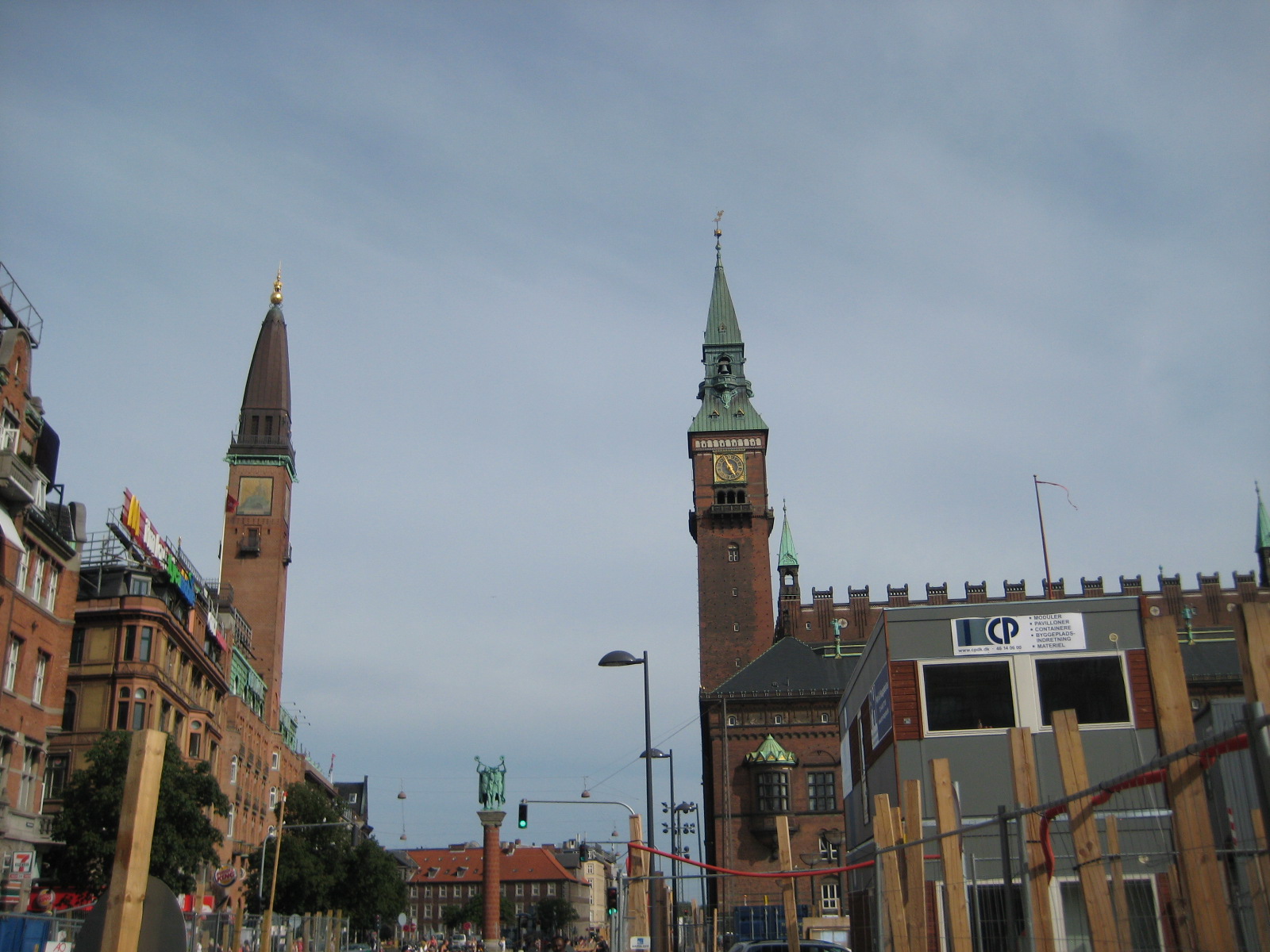
The Rådhus:


            By this time we were pretty exhausted from a full day of walking and touring, so we headed back towards our hotel by way of the Rådhuspladsen square at the city center. Overlooking the plaza is the Rådhus, the town hall of Copenhagen. A charity-event box-mini soccer game was going on in the square, so we stopped and watched for a little bit to rest our legs before heading back for a nap. We woke up fairly late, grabbed a late dinner at a restaurant nearby called Haiku Sushi, and stayed inside for some time while it was raining. When the rain stopped, we ran over to a bar recommended to me by my friend Matt Collins called Den Glade Gris, or The Happy Pig. They had a shot-special of 10 shots for 100 DKK, so we had that and a couple beers before heading back to the hostel bar to see what was up there. After a beer at hostel bar, we noticed that a group of four was planning to walk over to Christiania. We joined them, and soon learned that two of them were Belgian private-plane pilots, and the other two were Germans from Munich, a boy and girl. We walked with them the twenty-five or so minutes to Christiania.

The Flag of Christiania:


            Christiania is possibly the strangest place I have ever been in my life, especially at night. This little park area is technically not governed by Copenhagen, and is basically a free-spirit commune or anarchist society. The area is adorned with graffiti art, random metal art-structures, and tons of little shops. It is particularly controversial, however, in that it is an area where the 850 or so inhabitants are legally allowed to sell marijuana, hashish, and other “soft-drugs.” I should note, that they are particularly against “hard-drugs” and openly enforce this as well as prohibiting pictures of their famed “Pusher Street.” We walked through here for a bit, sticking together, and made our way to the local pub Woodstock for a beer—a Christiania beer brewed right in their commune. It was getting late, so after a beer or two we took a cab back to the hostel for another drink and went to sleep around 3am. What a long day!

Wednesday, June 22, 2011

Denmark: Day I (Copenhagen)

Tuesday, June 7th:

Downtown Copenhagen:


Jen and I woke up this morning and headed straight to the airport for a short, hour-long flight from Stockholm to Copenhagen, Denmark. I enjoyed my fairly short stay in Stockholm, and definitely think a return visit is in the cards sometime in the future. My only gripe is that it is so expensive for drinks and food… Anyways, Adjö Stockholm! And Goddag to Copenhagen!
            Copenhagen, or København as the Danish call it, is an absolutely beautiful city, and a traveler can see this as soon as he or she steps out of the central train station. The architecture is awesome to look at, and stunning steeples of palaces and churches line the skyline in every direction. The center of the city is a mere ten minute train ride from the airport, and Jen and I walked another ten minutes with our luggage to our hotel, the Danhostel Copenhagen Downtown hostel. This hostel is in a perfect location, just steps from the Rådhuspladsen square which serves as the center of downtown Copenhagen. It also has a pool table, foosball table, a café, and a bar in the lobby. Here I picked up my Hostelling International Card to help with some prices later in my trip, and we checked in to the trendy hostel and made our way to get lunch. We found a place called the Rio Bravo Restaurant that sounded American or Mexican but served traditional Danish foods. I ate a beef tenderloin clear soup with meatballs and a dish called Stjerneskud which consisted of Boiled and Fried Filets of Plaice with caviar and vegetables. Jen also had some smoked salmon and a side salad here, and I tasted some Danish Aquavit alcohol for the first time—it is pretty good!

The Center of Downtown Copenhagen, the Rådhuspladsen:


            We went back to the hotel for a nap before going back out to get a feel for the city. It was pretty dead, being a Tuesday night, but we found a fairly lively bar called the Viking House where I had some pints of Carlsberg, the local beer, or øl in Danmark (yes, in Danish it is spelled Danmark), brewed right in western Copenhagen city in the district called Frederiksberg. After a few beverages, we wandered our way back to the hotel to get some shuteye early(ish) to make breakfast and get out touring on the early side the next morning. I was very eager to see all the sites that this city had to offer! Luckily almost all the Danes here speak English, because Danish is also a very, very strange language. Swedish was understandable at times, but this one just sounds so much weirder…

Tuesday, June 21, 2011

Sweden: Day IV (Stockholm)

Monday, June 6th:

Drottningholm Palace:


            Happy Swedish National Day to all of Sverige! Unfortunately all the shops and some restaurants in Stockholm are closed this day, but it was an exciting surprise as I had no idea that I would be in the country for this holiday! Jen and I woke up early again for the hotel breakfast, then made our way to the subway to the Brommaplan station. There we got on a bus to Drottningholm, as we wanted to go see the Drottningholm Palace—the summer home for the Swedish Royal Family. The trip out to the palace takes about thirty minutes each way.
            At the palace, Jen and I toured around its rooms and gardens. In a very French-Renaissance style, Drottningholm Palace reminded me a lot of the French castles and Versailles I had visited in the past. Even its long gardens and fountains were in the same vein as Versailles. We took a long walk down the gardens to also visit the Royal Chinese Pavilion, an old gift to the Royal Family. The pavilion seems almost like a place of escape for the royal families of the past, as it is so secluded and in the woods. On the way back towards the bus stop we also saw a parade of people dressed in traditional Swedish outfits and playing music for the holiday. Fun stuff!

Drottningholm Palace and Gardens:


            Back into the downtown Stockholm area, we went to lunch in the shopping district on Birger Jarlsgatan. Props to Nick DiNorscio and his Stockholm-born friend Christian Stenberg for recommending Restaurant Riche to me for this lunch. Riche is where I devoured my favorite meal of the trip so far, traditional Swedish Meatballs with a cream sauce, lingonberries, and sweet pickles. After lunch we took a long stroll down the waterfront and docks next to Strandvägen on our way to the Djurgården district of the city. Djurgården is home to a series of museums, a massive park, and Stockholm’s Gröna Lunds Tivoli amusement park. We went into the Vasa museum, a museum specially built to hold one of the oldest recovered warships in the world, the 17th century Vasa warship. The ship sunk on its maiden voyage and was recovered after 330 years at the bottom of Stockholm harbor, and it is now on display at the most visited museum in Scandinavia.

The Beautiful Waterfront of Stockholm:


We walked around the beautiful Djurgården park for a while enjoying the sunshine and 75 degree weather before heading back towards the hotel. On our way back we stopped at a dockside bar and drank a pint of Spendrups Bryggeri beer while a holiday parade went by. When we tried to cross the Strandvagen road to go to the train station, the Swedish military police were blocking it off and would not let us pass. We decided to stick around for a bit to watch what was in store, and soon enough, we heard the footsteps of horses and royal trumpets sounding into the air. Following the multitude of royal guards on horseback were two carriages, one carrying the King and Queen of Sweden, and the other carrying the two princes and princesses of the nation. It was a pretty ridiculous and awesome sight to see.

The King and Queen of Sweden:


We finally got back to our hotel after a lot of sightseeing and decided we wanted to visit the Södermalm district in the southern part of Stockholm for a change of scenery. We made our way down there by subway for dinner and some drinks, and immediately noticed that tons of students and younger adults hang out in this area. As soon as we left the subway we entered a massive square with tons of outdoor bars and a free Swedish techno concert happening! We walked around the area looking for a suitable dinner venue and settled on a Swedish-Thai mixed restaurant called Koh Phangan. Here I had a very spicy salad, and an even spicier dish of whiskey marinated Squid and Seafood Medley with cooked vegetables, and Jen had a Thai Curry Scampi. Both were very tasty! We made our way back to the square for some drinks, and although the free concert had ended, one of the bars called Snaps Bar and Grill had its own DJ spinning some Techno for its young crowd. We drank a couple Pripps Blå beers here, a Swedish brewing company out of Gotenburg, before leaving around midnight to try to find a club to dance at.

The Nordic Museum of Stockholm:


            After realizing that not too much was going on in Södermalm on the Monday holiday, we walked back to Gamla Stan to find some more open bars. We stumbled into a Swedish Rock Bar briefly, and although it was very authentic and had good (for my taste) music, we left to find something more suitable for the both of us. We ended up spending the end of our night at a bar called Restaurang Movitz where we could drink and dance with some locals. The bartenders were very fun and got into the dancing and spraying the crowd with the bar water tap too! At about 1am, when the bars in Stockholm close, we made our way back home on the long walk and fell asleep promptly after a tiring day!

Friday, June 17, 2011

Sweden: Day III (Stockholm)

Sunday, June 5th:

Klara Kyrka:


            Today Jen and I began our sightseeing in Stockholm. We woke up early for the hotel breakfast of cereal, yogurt, granola, and veggies before heading out. We decided to explore using the Stockholm Tunnelbana (subway) system, and took a train to T-Centraalen before walked towards the Stadshuset (City Hall). On our way we also stumbled into a beautiful church in the downtown area called Klara Kyrka with a service going on. We continued our walk until we found the massive brick building and went inside with the entrance fee. A note here: Stockholm’s museums and sights are not too expensive (and the US:Swedish currency rate is about 1:6, as Sweden is part of the EU but uses its own currency, the Swedish Kronor) but the city’s restaurants, clubs, and bars are very expensive.

The Gold Hall of The Stadshuset, Stockholm City Hall:


            The Stadshuset, or Stockholm City Hall, is less than one hundred years old but the architect built it to look like it is much older, perhaps to match the buildings in nearby Gamla Stan. The biggest attraction of the Stadshuset is the Blue Hall, where the annual Nobel Prize Banquet is held. Another part of the City Hall that was very interesting is the City Council Chamber, where the Stockholm Innerstaden (Inner City) council has its meetings. In Sweden, women are particularly advanced in the workplace and society, as shown by the fact that the City Council has a majority of women in its 101 seats. Farther along our tour, we also came to the Gold Hall, a room filled with gold mosaics of Swedish history, where the Nobel Banquet Dance is held after the dinner in the nearby Blue Hall.

Riddarholmskyrkan:


            Following the Stadshuset visit we walked over to Gamla Stan again and visited the Riddarholmskyrkan (Riddarholmen Church), the second oldest structure in the city. This church-turned-museum is a royal tomb and the site of many royal funerals over its eight-century existence. The church holds the tombs of former Swedish Monarchs Magnus III, Charles VIII, Gustavus Adolphus, and Gustaf V to name just a few. It also holds hundreds of coats of arms of the dead members of the Order of the Seraphim, a Royal order bestowed upon nights by the Swedish monarch. After the Riddarholmskyrkan we walked to go get lunch near the Kungliga Slottet (Royal Palace) and heard a ton of trumpets. We realized that it was 1pm and the Sunday Changing of the Guard was just about to happen! We hustled up the hill to the Palace gates to watch this event unfold. A group of Royal Guards, led by police and trumpeters walked into the gates to replace the other guards there as they do every day at noon (1pm on Sundays). It was quite the fanfare and quite amusing to watch the Swedish military guards try to keep the crowds in order. We watched this for a while before heading back towards Storkyrkan (The Cathedral of Stockholm) for lunch again. This time we ate at a quaint little basement café called Café Sten Sture. I had a traditional Swedish lunch of Shrimpmix in a baked potato, while Jen had a mushroom crepe. We also tried a Swedish dessert called a Daimcake that was very tasty.

Changing of the Royal Guard at the Swedish Royal Palace, Kungliga Slottet:


Following lunch we took the short walk to the Storskyrkan and went inside. Much like Riddarholmskyrkan, this church also housed tombs of important Swedish figures, but most importantly, the famous statue of St. George and the Dragon. It is a very brilliant sculpture made over 400 years ago, and worth the visit. We then walked over to the Kungliga Slottet (Royal Palace) to see its many museums. On one ticket, tourists can visit the Royal Armory, the Royal Apartments, the Tre Cronor Museum, and the Museum of Royal Antiquities. We also opted to see the Royal Treasury where the crown jewels of the monarchs are kept. Inside the Armory is tons of artifacts relating to ancient Swedish royal rule and warfare. The Royal Apartments exhibit the guest apartments as well as some of the rooms that the King and Queen and their family still use today. We did not make it inside the Museum of Royal Antiquities, but the Tre Cronor museum is in the basement of the palace and shows artifacts and pieces of the old Tre Cronor Palace that stood on the same foundation as the current palace until it burned down in 1697.

Sculpture of St. George and the Dragon inside Storskyrkan, the Cathedral of Stockholm:


            On the walk back to the hotel, we stopped for a Swedish beer, or öl, called Falcon at a nice scotch bar called Pickwick’s. Falcon is very tasty, one of the only Swedish beers around, and comes in at a whopping 7.2% alcohol-by-volume! We were exhausted from the long day of touring the city, so both Jen and I passed out for about a four-hour nap before we realized that all the dinner restaurants would be closed! We woke up in a hurry and scrambled out to find a restaurant called Falafel Kungen that was still open, and I got a Chicken Kebab Wrap while Jen got a Falafel. After dinner we just headed back and went to sleep so we could have breakfast early in the morning and visit Drottningholm Palace, the summer residence of the Swedish Royal Family! Also, tomorrow is June 6th, National Day in Sweden!


Kungliga Slottet, the Swedish Royal Palace:


Monday, June 13, 2011

Internet Issues

Bare with me folks, I am having trouble finding reliable internet. I have the posts typed up, I just need to find a good enough signal to post them.

-Rog