Sunday, August 21, 2011

Germany: Day I (Berlin)

Wednesday, June 15th:

Boston Bruins Captain Zdeno Chara Holding the Stanley Cup Trophy:


The Boston Bruins are the Stanley Cup Champions of 2011!!!!!!!! It feels so good to say that, and I am so excited!!! I am very lucky to be able to say that I have witnessed a championship in all four major sports for my hometown city of Boston in only ten years. Pretty remarkable, but more on that in a bit.
            Today was the first time we got to use our EU-Rail Passes on the European international railway system! We slept in a little this morning before waking to pack and eat a quick hotel breakfast before making our way to Prague’s Hlavní Nádraží train station. We got our passes activated and got on our train to Berlin at about 2:30pm. We did not wander down into the dining car, which I regretted because I basically ate a Snickers bar and some dried pineapple for lunch (Jen smartly ordered some Pasta-To-Go at the Prague train station), but the train was very smooth. We rode by a really cool castle and bridge in Northern Czech Republic before crossing the border into Germany and stopping at Dresden. Dresden looked fairly small but really pretty with its old churches, and it felt cool to be in the city of the famous fire-bombing which provided the background for my favorite book, Slaughterhouse Five by Kurt Vonnegut.

The Kaiser Wilhelm Memorial Church at Night:


We rolled away towards Berlin in no-time, passing plains that looked like the sets for Saving Private Ryan and Band of Brothers. We got to Berlin and to our beautiful hotel, the Brandenburger Hof in the western Berlin area of Wilmersdorf at around 8pm. This hotel, despite being fairly small and not too pricey, is an amazing five-star hotel and it was a very nice break for Jen and I from all of our hostel travelling up until now. We got a quick nap in because I had told Jen that tonight would be a long night, as I had found a bar, Belushi’s All Night Sports Bar, that would be playing game seven of the Stanley Cup Finals, starting at 2am. We got dinner in the area known as Savigny-Platz at a Jamaican restaurant called Tastees Soul Food (we were hungry…). I ate some veggie soup and Jerk Chicken with plantains and dumplings, while Jen ate some Steamed Red Snapper with the same sides. It was fairly good, but we were just looking for some food as it was late and many restaurants were closing their kitchens.
My brother, Brad, had told me that the subway system in Berlin was as super efficient, so we tried to use it to go across the city to Rosa-Luxemburg-Platz where the bar was located, right next to the Berlin TV Tower, which is the tallest building in the European Union. While it looked to me like the system was as-advertised, we had some serious issues as one of the lines was having work done on the middle of it, right near our hotel. After struggling with this for about forty-five minutes, we just decided to take a cab across the city to the bar. When we got to Belushi’s, it dawned on me that it was a bar inside the great chain of hostels called St. Christopher’s, which a friend Cole Lupoli had recommended to stay in. Unfortunately for me, the inside was filled with a ratio of about 40:5 Vancouver Canucks fans to Bruins fans, but I was not deterred. Waiting for the game to start I enjoyed some Lübzer beer on tap (for 2 Euros!) and chatted with a Czech man who grew up in London but now lives in Berlin (yeah, I dunno). Strangest of all, he was a massive hockey fan, and a Bruins fan to boot! I also hung out with a Vancouver fan that seemed tamer than the others. When the tap ran out, we also drank some Franziskaner Weissbier, which was supremely tasty to me. Best of all, the Bruins were winning!

The Fernsehturm (TV Tower) at Night:


By the time the sun came up outside, the Bruins were minutes away from their first Stanley Cup Championship in thirty-nine years! Brad Marchand scored an empty-netter goal to seal the 4-0 victory, and my nervous shaking turned into pure excitement and joy. It was after 5am in Berlin, and I could have been the happiest person in the whole 3.5 million person city! The Vancouver fans congratulated me, and I stayed to wallow in the joy of watching my team skate the coolest trophy in sports around the ice. By now, Jen probably wanted to kill me as I had kept her up all night and was screaming and shouting like a madman, so we took a cab home around 5:30am. Before we got in the cab, however, we walked outside and watched a young Berliner get tackled by two cops as he ran down the street away from them. Good start, I guess?

Wednesday, August 17, 2011

Czech Republic: Day IV (Prague)

Tuesday, June 14th:

The Entrance to the Hradčany Side (Castle District) of Prague from Charles Bridge:


            Just to preface this awesome day, Prague Castle is in the Guinness Book of World Records as the largest castle in the world. It is magnificent, and we got to tour it today! Good news to wake up to, the Boston Bruins hockey team had won game six of the Stanley Cup finals, so Wednesday night (Thursday morning actually, at 2am) will be the winner-take-all match. I am getting the chills just thinking about it! I also scoped out a bar in Berlin to be able to watch, so I am super excited. Anyways, we started our day off again with the hotel breakfast, then walked towards Bethlehem Chapel where Jan Hus used to preach against the church teachings of his time in the 15th century before he was burned at the stake. To begin our little bit of bad luck today, the Chapel was closed, so we walked into the St. Martin-in-the-Wall Church and a couple others on our way to the massive Karlův Most (Charles Bridge). This bridge dates back to 1357 to connect Old Town to the Lesser Town (Malá Strana) and the Castle District (Hradčany). It offers breathtaking sights of Old Town and the towers and chapels of Lesser Town, as well as Prague Castle standing above everything. It also has towers on both sides built in what I now believe should be called “Prague-gothic style” as most of the buildings were originally designed by similar architects.

The Interior of the Church of St. Nicholas (Hradčany Side):


            We walked across the bridge to Lesser Town and found our way to the famous Lennon Wall of Prague, a wall dedicated to John Lennon of the Beatles, and more importantly, to the peace and love that he stood for. The wall is covered in spray-paint art and sayings promoting peace. We then began our walk uphill, first stopping at the (other) Church of St. Nicholas. This church is much bigger and even more stunning than its counterpart with the same name in Old Town. This is where my camera troubles began, as my charger broke and I had run out of batteries, but I had found a temporary solution by buying a new charger and battery, and luckily the new battery had some charge in it right out of the box. We then moved up the New Castle Stairs up to Prague Castle.

The Entrance to Prague Castle:


            Our first view of Prague Castle was of its main gates, guarded by modern guards who are there to protect the president of the Czech Republic who resides inside the castle today. The castle is also situated above the entire city, and everywhere is filled with beautiful views of Prague. We went inside and purchased our tickets, 450 CZK for two “Long-Visit” tickets, plus two maps, and two photo permits. I should note that the Long Visit is kind of a bit much, especially since a couple of the places aren’t completely worth visiting, and the photo permits are kind of a ripoff because I think everyone was again taking pictures regardless of if they had it or not. We also had very good timing, as we walked by at the perfect time to see the changing of the castle guard—we had now seen this in three out of three countries!

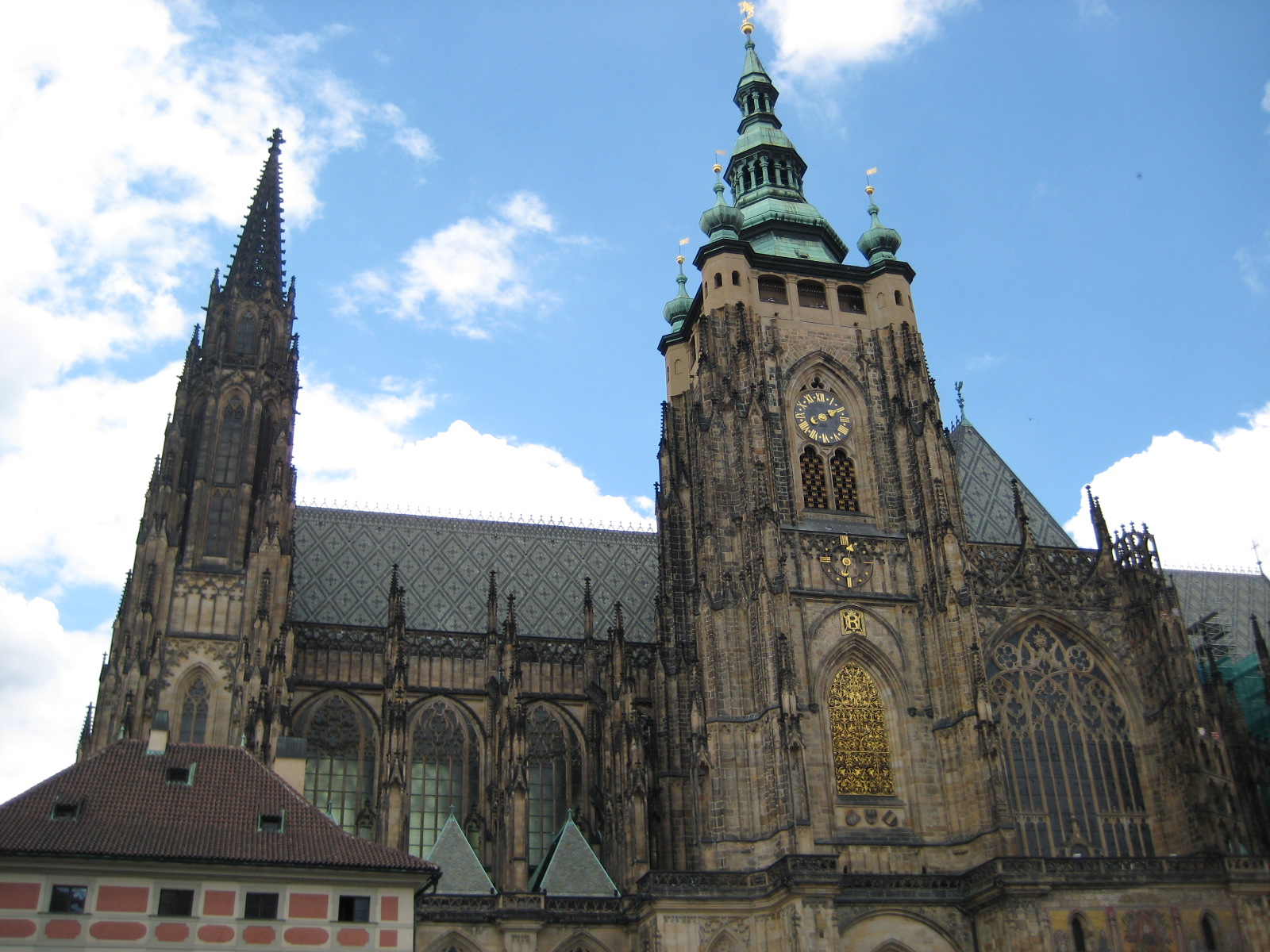
The Cathedral of St. Vitus at Prague Castle:

Anyways, upon walking inside the main gate you are immediately confronted with the massive and awe-inspiring St. Vitus Cathedral, the main church on the Prague Castle property that has seen ongoing construction and additions between the 10th century and the early 20th century. We went inside here and immediately were struck with the brilliance of this site. Flanking the left and right sides of the cathedral at the entrance are six massive stained glass windows that illuminate the church with bright, vibrant colors. We walked farther down the left side and admired all the side-alters and sites there to see. At the back of the church is a massive silver shrine and the tomb of St. John of Nepomuk as well as a dozen or so more enclaves, each with stained glass windows and golden or baroque catholic shrines. Continuing our walk around the church, we got to the door to St. Wenceslas’ Chapel, which, to our bad luck again, was closed. I was fairly upset about this one, because inside the chapel is the tomb of St. Wenceslas, as well as the door to the Royal Jewels room, which is locked to the public. The Royal Crypt was also closed, so we did not get to see the tombs of such monarchs as Charles IV and Rudolf II. We stayed in St. Vitus for probably over an hour, just admiring its beauty, before we left.

The Bohemian Crown Jewels (Unfortunately, Copies):


            It was this point that I realized I had left my favorite Bruins hat in the Church of St. Nicholas, so I literally sprinted the hundreds of steps back down to retrieve it before going into the Old Royal Palace. I think there were also some rooms in here that were closed, as the palace seemed like a very short visit. We did not get to see the All Saints’ Chapel nor some of the Chancellery rooms, but we did get to see the famous (and massive) Vladislav Hall. This room is used for coronations, jousting tournaments, and modern day presidential inaugurations. We also got to peek into the Diet chamber, or throne room, which displays a case filled with the Bohemian Crown Jewels! Unfortunately, these are copies, but it gives tourists a really good idea of the magnificence of the originals that are locked away from the public. We also saw the famous “Window of the 2nd Defenestration of Prague” which basically started the Thirty-Years War.

St. George's Basilica:

            We soon walked over to the Romanesque church known as St. George’s Basilica, built in the 10th century and dedicated to the same St. George that has a sculpture in the Cathedral of Stockholm that I visited in Sweden about a week earlier! This church also reminded me of the Chora church in Istanbul, Turkey. It is very old, and apparently has a massive crypt underneath, as tombstones and sarcophagi are displayed from some of the excavations in years past. After this church visit, we both ate a vegetarian burrito for lunch at the café outside of the Rosenberg Palace where I also grabbed some much-needed charge for my camera battery. We went inside the Rosenberg Palace next, which seemed again very short and almost meaningless (this is one of the places that is on the Long Visit ticket that I would not recommend). We left there and walked over to the Golden Lane, the area of very tiny and brightly colored houses that housed castle guards in the 16th century who undertook various crafts in their spare time. Franz Kafka also lived in one of them for two years. Inside the houses are displays of the lives of those who lived in them, and some of them have been turned into shops. Upstairs in the houses is a large display hall of old suits of armor of days long ago, as well as a rather funny chance to shoot three shots of a medieval crossbow for 50 CZK—I passed on this opportunity.

One of the Tiny Houses of the Golden Lane:


            Jen wanted to go into the National Art Gallery inside St. George’s Convent next, and while I wanted to I also wanted to climb the 287 steps up to the top of the south tower of St. Vitus Cathedral, which affords the climber an unparalleled view of Prague. The price at 150 CZK is a little steep, but it is pretty cool to be so high up there. After I climbed down, I did probably the world’s fastest tour of the National Art Gallery, stopping at a few that I really liked, as I tried to catch up with Jen. I finally found her and we walked over to the last stop inside the castle, the Powder Tower. It was in here that gunpowder was stored, and today it is a two-story museum dedicated to the castle guards, their responsibilities, their weapons, and their uniforms over their history.
            We soon left Prague castle to search for a monastery that my brother, Brad, had recommended to go see because they brew their own beer! We walked up the cobblestone street for about one kilometer, passing old palaces that had been turned into hotels and restaurants seemingly with each twenty steps, including the massive Schwarzenbersky Palace. This area on top of the city is absolutely beautiful! On our way up to the monastery we also passed the Loreta church, and while the interior had closed for the day, we got to explore its beautiful exterior before continuing our walk. When we reached the Strahovský Klášter (Strahov Monastery) we found two massive churches standing above the small white buildings. This monastery has been in existence since the 12th century! Another large building stands next to the main church and is the monastery library. This library was also closed, however it is filled with ancient Czech texts including the works of Tycho Brahe. We made our way into the St. Norberts brewery and sat down to taste their work. First on the menu was their Amber beer, a mix between the Vienna Lager style and the Bavarian Märzen style. Next came the Müncher Dark style, then an IPA and finally, a Belgian Wheat. All four were awesome, and I personally liked the dark style beer the best.

The Loreto Church:
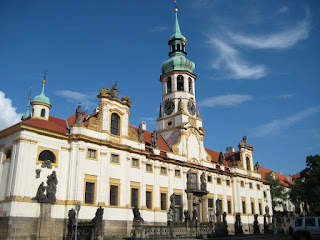

            We worked up an appetite after drinking the wonderful monastery beers, and we only had a short walk to a beautiful looking restaurant called Bellavista. It gets its name because the restaurant sits on a terrace that looks out over all of Prague, including Prague Castle itself. This is one of the more picturesque locations in the city, let alone spots to eat dinner! For dinner Jen ate Risotto with mushrooms and truffle oil, while I ate Traditional Czech Roast Beef with a vegetable sauce. With dinner we also ate a potato and vegetable Czech soup, some bruschetta with pesto and dried tomatoes, and a bottle of Czech wine (which somehow the name is escaping me right now). The dinner was delicious, and the only thing that would have made it better is if a thunderstorm had not rolled through while we were eating! Luckily we were under a tent outside, but it did start raining very hard and we had to wait it out before walking home. We made the long walk home down the Old Castle Stairs and across the Vltava River and through Old Town.

Jen and I Dining at Bellavista, with Prague Behind:


            Before going to bed, we stopped in a luxurious looking bar/lounge called Bed Lounge where we enjoyed a few drinks. I had some more Absinthe here, using the traditional method of pouring water over a sugar cube on a slotted spoon and enjoying the drink afterwards. This place was very fun to hang out for a little while, because we could rest our tired legs on the fun beds they have set up all over the room to relax on while you sip your beverage. Following a few drinks, we walked the short walk home while dodging raindrops. Tonight was our last night in Prague, and I will be sad to leave this city, as it has a certain charm that I have never experienced anywhere else. Ahoj Prague!


Charles Bridge as seen from the Old Royal Palace at Prague Castle:


Monday, August 8, 2011

Czech Republic: Day III (Prague)

Monday, June 13th:

The Spanish Synagogue:


            Today was a pretty intense day of touring. We woke up fairly early and ate the hotel breakfast before heading out to check out the Jewish Quarter of Old Town and to explore the Jewish Museum of Prague. Do not be fooled here though; the Jewish Museum of Prague is not just one museum, but rather a collection of sites including five synagogues, a ceremonial hall, and a cemetery. The first site we entered was the Spanish Synagogue, widely considered to be one of the most beautiful synagogues in Europe. The entire interior is decorated with golden tiles and colorful designs—it is truly pleasing to the eye! Both the upstairs and downstairs of the synagogue are also filled with display cases featuring historical items of the history of Jews in Prague and the Czech Republic, mainly focusing on the 20th century, World War II, and life after the Holocaust or Shoah. They have lived there for over one thousand years and been through many periods of struggle and grandeur alike. Another funny revelation here, the entire Jewish museum does not allow photos inside the synagogues, but since there is nobody telling you not to, nearly every tourist with a camera takes pictures anyways, and I followed…

The Old-New Synagogue, and the Jewish Quarter Town Hall:


            Next we went into the Old-New Synagogue, which is the oldest continually operating synagogue in Europe, dating back to the mid-13th century. The building is very basic on the exterior and interior, but it is the age of it that is its charm. This is also the first place that I was required to wear a yamaka, in keeping with the traditions of the Jewish faith. Immediately next door to the Old-New Synagogue is the Jewish town hall, and while we did not go inside it is interesting in that it keeps time in Hebrew numbers counterclockwise on a clock adjacent to the main clock on the top of its steeple.

The Jewish Ceremonial Hall:


            Our next stop was the Jewish Ceremonial Hall attached to the Klausen Synagogue. The Klausen synagogue depicts the daily lives of Jewish citizens in Prague and Jewish celebrations. The Ceremonial Hall is slightly grimmer, as it focuses on the Jewish Burial society and the traditions of burying the dead, as the Old Jewish Cemetery is immediately behind it. I had no idea about these traditions, so it was very interesting to learn about them. Following this stop we walked over to the Maisel Synagogue which is filled with historical items and facts discussing the lives of Jews in the Czech Republic from the 10th to the 18th centuries. Some of the artifacts were extraordinarily old, and it was cool to learn about major figures in a period of history and subject that I knew very little about.

Inside the Pinkas Synagogue (Those are all Names on the walls):


            Our next stop in the Jewish Museum tour was the Pinkas Synagogue, which you also must walk through to get into the Old Jewish Cemetery. The Pinkas Synagogue is by far the most solemn and disheartening place in the Jewish Museum, and tourists immediately notice this when they walk inside. Prayer songs are played softly as you walk around, and the basic interior walls are covered with the names of the nearly eighty-thousand Moravian and Bohemian Jews killed by the Nazis during World War II. It is absolutely remarkable to see these names covering the walls in such a manner, and you are filled with all kinds of emotions as you tour this synagogue. Upstairs is another exhibit featuring artwork created by children at the Nazi concentration camp known as Terezín. Many of these children did not survive the Nazi “final solution,” and it is another painful reminder of the horrific war crimes of Nazi Germany.

The Old Jewish Cemetery:


            We then moved on to the Old Jewish Cemetery, which is the final resting place of all Jews in Prague who passed away between the 15th century and the late 18th century. The oldest grave inside is marked 1439, and many of the chief Rabbis of Prague rest here. The space is so small that the graves had to be stacked, so the cemetery is actually about eight feet above the streets around it. 12,000 or so grave stones are visible above ground while thousands more lay beneath them. A path is set up so visitors can walk through the graveyard and admire the gravestones that lie at all angles across the tiny plot of land. Following our walk through the graveyard we walked over to the Rudolfinium theatre building, then got hungry. We had wanted to get a traditional Jewish lunch as that was our theme for the day so far, but instead we settled on a restaurant called La Veranda. Here we ate a mozzarella and eggplant salad and both Jen and I had a cold tomato soup with eggplant and tomatoes inside it. I also had a pint of Pilsner Urquell, a beer I had tasted before but had to drink it again as it is brewed in Plzen, Czech Republic.

The Astronomical Clock:


            After lunch we walked across Old Town to the Astronomical Clock attached to the Old Town Hall building. We wanted to come here to see its famous animations as the clock strikes a new hour. The clock, dating from the 15th century, indicates time by the season, zodiac sign, and position of the sun and moon. As the clock strikes the new hour, a skeleton rings a death bell and turns his hourglass upside down. Windows on the top of the clock open and the twelve apostles walk by. As the animation ends, a golden cockerel flaps its wings and crows. The fanfare is topped off by a city-worker in traditional Bohemian Guard dress playing a trumpet at the top of the gothic Old Town Hall Tower. We had planned on going up to the top of the tower next, but had to wander around to find an ATM so I could get the cash to go up (50 CZK each for students). While looking for one, we also stumbled upon another massive church that we checked (Czeched, haha) out. We walked back to the Old Town Hall and took the elevator up to the top. The building was built around 1500 and offered spectacular views of the whole city, especially of Prague Castle and the Týn Church across the square.

View towards Prague Castle from the top of the Old Town Hall:


            We left the Old Town Hall Tower and walked towards the Jerusalem Synagogue near the main train station. To our misfortune, the synagogue was closed—pity because it is super colorful on the exterior and I had heard it was beautiful inside as well. Walking towards New Town (Nové Město) we passed the Estates Theatre, the location of the premiere of the Mozart Opera “Don Giovanni in the late 18th century. We continued to Wenceslas Square, named for St. Wenceslas, where over 500,000 students gathered to protest the Communist regime in control at the end of 1989—now known as the Velvet Revolution. The square is massive, and at one end is the beautiful National Museum in gold and a massive statue of St. Wenceslas. There is also a very interesting wall dedicated to post-World War II history of the former Czechoslovakia, Democratic Republic of Germany, and Hungary. We continued our walk towards New Town Hall, the site of the world’s first defenestration! The building was unfortunately closed, but we continued walking to Charles Square, now a park where we rested and visited another magnificent church.

Wenceslas Square and the National Museum:


            Walking back towards our hotel, we stumbled upon the smallest brewery in Prague! I was really excited, so we went inside Minipivovar U Medvíků to taste a few beers. We tasted their light beer, their dark beer called Oldgott Barique, and my personal favorite, the X-33 beer which tasted like whipped cream and clocked in at around thirteen-percent alcohol! We enjoyed these with an apple tart, browsed their store, and then walked the fifteen-or-so minutes home. Jen had a craving for some Chinese noodles, and luckily a restaurant called Moon was literally five steps from the front door of our hotel. We both ate some shrimp lo mein and got on the internet briefly at the hotel, finally. We were thinking of going to a club, but it started raining again and we decided to stay in again (I know, we were exhausted so the night-life in Prague didn’t happen very much for us…). Tomorrow will be our Prague Castle day! Hopefully the scattered showers will stay away and it will be like today: sunny and seventy-two degrees Fahrenheit.

Friday, August 5, 2011

Czech Republic: Day II (Prague, Kutná Hora)

Sunday, June 12th:

The Church of Our Lady Before Týn:


            We woke up today for some touring but were saddened to discover that it was raining outside on the day we had planned to go to Prague Castle. We ate the hotel breakfast, which was typical and like the others—assorted meats, veggies, bread, juices, coffee, yogurt, granola, and cereal. We walked back over to Old Town Square and went inside the massive gothic church known as the Church of Our Lady Before Týn. No photography allowed inside, but this church is massive and gorgeous. I swear that Universal Studios used this church as the guide for building its replica of Hogwarts in the Harry Potter part of its amusement park in Florida. The church stands above just about everything else in Old Town, and inside it is adorned with gold alters left and right. Coolest of all, to me at least, was the fact that the tomb of the great astronomer Tycho Brahe is inside this church, located just to the right of the main altar. The church is one of the most spectacular Catholic churches I have seen in my life. After the Týn Church we quickly went back inside the Church of St. Nicholas to take a few pictures as we had forgotten our cameras the day before. We then realized that we needed more waterproof clothing and that I had forgotten the map, so we ran back to the hotel.

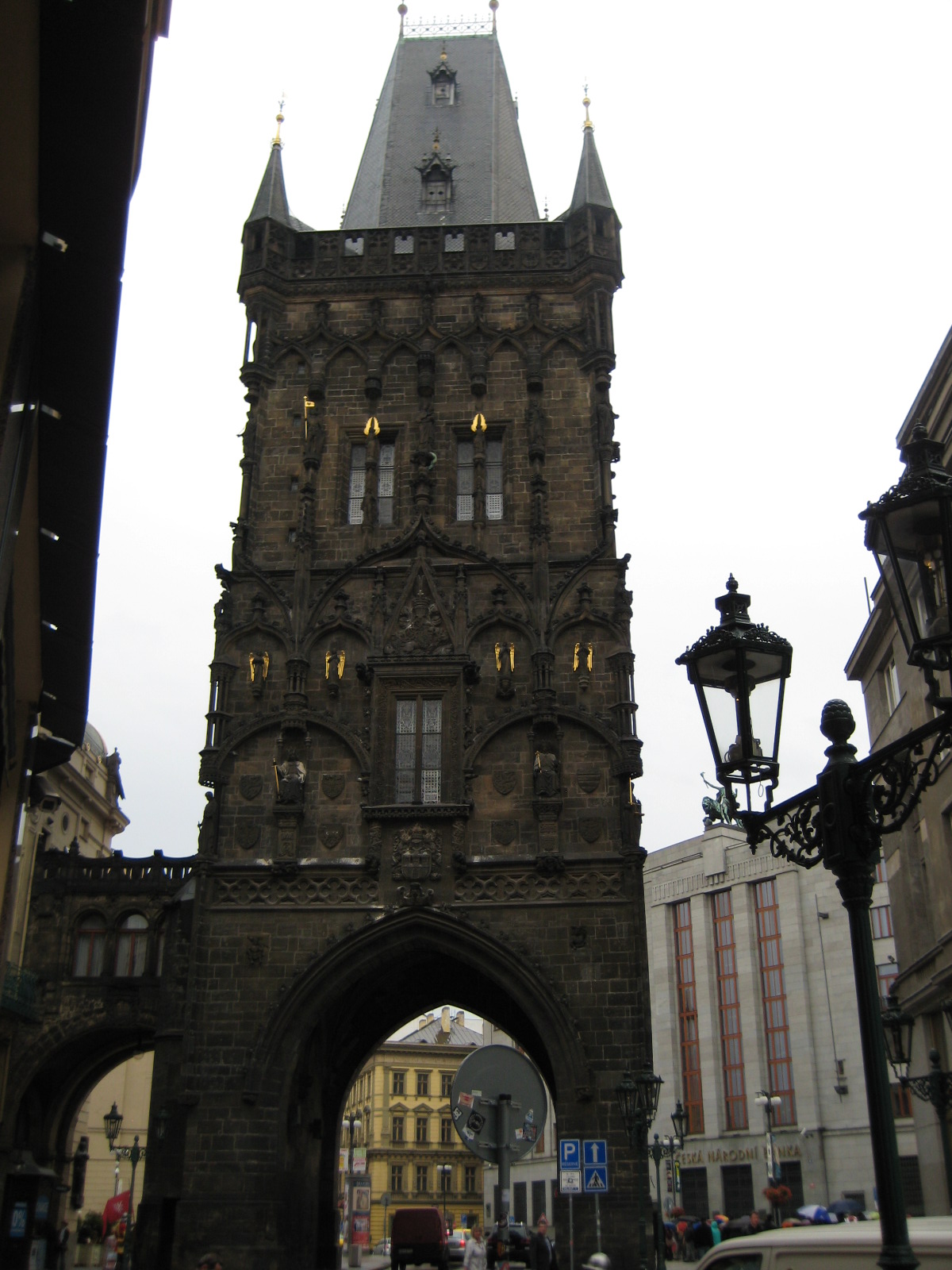
The Powder Gate, or Tower of Prague:


            At this point it began to rain very hard, and we wondered what we should do for the day. We had also heard that there was going to be a public transportation strike the next day, so instead of trying to deal with that on Tuesday when we had wanted to go to Kutná Hora, we decided to go today. We walked over to the main train station, Hlavní Nádraží and took a train to Kutná Hora through the town of Kolín. On our walk we also passed some magnificent buildings such as the Powder Gate tower, also referred to as the Tower of Prague, and the Municipal House theatre. The train trip took about one hour, and we met two girls from San Diego who were looking for the same famous “Bone Church” that we were. My brother, Brad, had told me about this church, actually called All Saints’ Chapel (or more commonly, Kostnice, which means ossuary), is located in the Kutná Hora suburb of Sedlac, just up the hill from the town. The Bone Church dates back to the 16th century when monks cleared out a cemetery and decided to use the bones to decorate the church. Inside the chapel is a massive chandelier, candelabras, pillars, and pyramids all adorned with human bones. Some of these bones are even from warriors of the Hussite Wars of the 14th century. We also visited the massive Church of the Assumption of the Virgin Mary across the street from Kostnice before heading into town (after a detour of a twenty minute walk in the wrong direction).

A Bone Chandelier inside the Bone Church (Kostnice):


            The walk from Sedlac to Kutná Hora is about twenty minutes, and we stopped at a convenient store for some yogurt, dried fruit, and a snickers for lunch as it seemed every café we found was closed for some reason. We toured around some of the Kutná Hora sites and churches before we headed down to the big St. James Church with its large, listing tower. The church was another beautiful catholic church and a lookout just outside of it offered us the first view of the church that Kutná Hora is famous for, St. Barbara’s Cathedral. We walked up the hill to this massive (again gothic) cathedral that looks more like a big-top circus tent from the distance. This building is massive and beautiful on the outside—I had never seen anything like it. The original church began in the late 14th century, and construction on it continued through the 16th century based on work from the same architects who designed the Powder Gate and St. Vitus Cathedral in Prague. Inside it is decorated with numerous gold alters and massive stained glass windows. We stayed in this building for a long time, as it was probably the most spectacular of the trip so far, before we made our way back towards the train station. On our way back we also stopped at a café to taste some Kozel Dark beer, and then made our train at about 7pm.

St. Barbara's Cathedral:


            Back in Prague we walked back towards the hotel and passed another beautiful gothic building called St. Henry’s Bell Tower, which keeps in line with the architectural style of the buildings that line the beautiful city skyline of Prague. We looked around for a dinner spot and ended up eating at a French-Asian fusion restaurant called Nostress. Here Jen and I both ate a Chicken and Shrimp dish with pan-fried rice Indonesian style. We also had an Ahi Tuna Carpaggio with lime, a bottle of Czech-made Pinot Gris, and a dessert dish which was basically a raspberry and strawberry crème cake. After dinner we walked around to some of the parts of Old Town that we had not been to yet, but decided that we were both tired and just wanted to take the rest of the night easy so we went to bed fairly early.

St. Henry's Bell Tower:


Internet Issues Remain

Hey all,

So sorry about my lack of posting for the last month or so, I have had really bad luck with internet at my places of lodging, and when I do find some it is not reliable enough to make a full post (i.e. it cuts me off mid-post... I has already happened two or three times to this very post). I will post when I can, however, and will keep posting until all is caught up.

Cheers!

Friday, July 8, 2011

Czech Republic: Day I (Prague)

Saturday, June 11th:

Old Town Square of Prague, with the Jan Hus Monument, and the Church of Our Lady Before Týn:


            Today we woke up super early to walk to the train station, get to the airport, and catch a 9am flight from Copenhagen to Prague, Czech Republic. The travel, while tiring, went without a hitch and we landed in Prague, or Praha, at around 1030am and made our way into the city center by taxi by around 1130. One great thing about this city is that the exchange rate (even though it has gone down in recent years) is wonderful at 15.5:1 Czech Koruna to US Dollar! Things are relatively cheap here still, even though tourism in Prague especially is driving up prices.

Dobry den Česká Republika!

First impressions on Prague: apparently the cities on my trip keep getting older and more beautiful. The skyline of Prague is lined with spectacular gothic spires of ancient churches, castles, and palaces from the Bohemian world of old. I had heard that Prague was a romantic city, but now I finally got to see it with my own eyes. Jen and I took a taxi cab from the airport to our hotel, the Hotel Rubicon Old Town in the Old Town district, known as “Staré Město.” [Note… since the language is so difficultly written and has so many foreign characters, I will only be using it for the really important sites/districts].

The Church of St. Nicholas:


We could not check in until 2pm, so we left our luggage at the hotel and walked through Old Town Square, the tourist center of the city. The square is built around two massive gothic towers and the monument of preacher Jan Hus, who was burned at the stake in the early 15th century. We peeked inside one site, the Church of St. Nicholas (which there are two of in the city), and looked around for some food. We settled upon a little place called Gurman Flint Bar and Restaurant, and had our first taste of the wonderful Czech Beer selection! Beer is literally cheaper than water in this city, and our first beer was called Kozel. I also ate some honey roasted pork (the Czechs are big meat…) with apple horseradish, vegetables, and potato pancakes, and Jen had a seafood salad.

Old Town Square at Night, with Old Town Hall and the Jan Hus Monument:


            We walked back to the hotel to check in and take a nap as we were exhausted from the early morning awakening for the airline travel. We woke up around 830pm and walked back to Old Town Square for some dinner under the beautifully lit up gothic spires surrounding us. We ate at a restaurant called Kammený Stůl where Jen and I both had Wild Boar Goulash with a red wine sauce—yes, Jen actually had a meat meal! We also sipped down a bottle of Lambrusco and I tried some Absinthe with the flaming sugar cube in it as an after-dinner treat. I had tried the stuff before, but not the real kind; it basically tastes like black licorice but if it was on fire. Intense stuff! After dinner we walked around Old Town a little more before heading back to sleep to be ready to tour the next day.

Tuesday, July 5, 2011

Denmark: Day IV (Copenhagen)

Friday, June 10th:

Christiansborg Palace:


            Our last full day in Copenhagen was a fun one and a beautiful day! We again went to a Koffe café, this time called Makkekafe, for breakfast, again scooping a croissant and some tea before heading to Christiansborg Slot (Palace). Christiansborg Palace was the site of six different castles that were destroyed, renovated, or burned down before the current one was built in 1928. The first of these castles was built in 1167 by Copenhagen’s founder, Bishop Absalon. This building is particularly unique in that is houses all of Denmark’s Legislative, Executive, and Judicial branches under one roof—one of the only buildings of its kind in the world. It is also used as a reception hall and gala venue for events held by the Queen of Denmark.
            Tourists can purchase a three-part ticket that allows them to visit the Royal Reception Rooms, the Ruins Museum under the Palace, and the Royal Stables. I should note that the Royal Stables have weird, weekend-only hours and we did not make it to see them, and also that the Parliament is available for tours if called ahead for. No photos are allowed inside the palace, per request of the queen. The first stop we made was the Royal Reception Rooms, which were absolutely magnificent. My favorite of the entire palace was a massive hall in which hang a couple dozen tapestries, made in 2000 by a Danish artist, depicting major episodes and events in the history of Denmark in a very modern style with bright colors. It was spectacular enough to prompt me to purchase postcards of all the tapestries so I could look at them more at a later time and to admire them. After going inside the palace, we went underneath it to the Ruins museum to see ruins of the old circular wall surrounding Bishop Absalon’s palace dating back to the 12th century. There were also other ruins of the old palaces, including the famous Blue Tower that served as a prison inside the palace for over a century.

The Old Stock Exchange Building of Copenhagen:


            We continued our day by walking towards the Christianshavn district, walking past the beautiful Old Stock Exchange building. We crossed the canal bridge and stopped to finally indulge ourselves with some Danish pastries! We stopped at a bakery called Lagkaghuset, again recommended to me by my friend Matt Collins. We purchased three items at this bakery, and each was delicious! First we tried a Christianshavnerkage, a little nutty cake with cream frosting on top. Second we tried a Hindbærbronbærkage, another little cake but this time more crunchy and covered in berries on top. Finally, we tried a Hindbærsnitte, which is basically a Strawberry Poptart but with real frosting and real jelly inside. All three were equally decadent, and I realized that if I lived there I would be a very large person.

Vor Frelsers Kirke (Our Savior's Church):


            We walked from the bakery next a short way to my favorite non-palace building of the trip so far, the beautiful Vor Frelsers Kirke (Our Savior’s Church). What makes this church so stunning is its sheer beauty both inside and out. Outside, on the top of the church, is a snail-shell shaped spire ramp leading up a gold and purple spire. At the very top is a modern statue of Christ, holding a flag, and standing on the globe in bright gold. Inside the church is a massive baroque wooden organ façade that dates back to 1660. Now that is what I am talking about! Furthermore, tourists are allowed to purchase a ticket to climb up the spiral ramp, or taarn, of the spire! Jen and I went up to the top and looked over Copenhagen on a particularly windy (which made it slightly frightening) but beautiful day. The ascent to the spire itself is really cool as you climb a series of super steep and old wooden stair sets through the bells and clock-workings of the tower. You can also see the Swedish coastal city of Malmö on the other side of the sound, and the largest car/rail bridge in Europe connecting the two countries.

The Baroque Organ Inside Vor Frelsers Kirke:


            After visiting the church we walked again the short distance to Christiania, the freetown society that we had visited two nights prior. It is much less creepy and sort of charming during the day. Pusher Street is still very weird and sometimes sketchy, with its “soft-drug” booths, but the rest of the town can be peaceful and pleasant, however there is always the faint aroma of marijuana in the air as youths and adults alike flock to “legally” indulge. We found our way through the parks to a restaurant in the back of Christiania called Morgenstedet, which means “good” or “pleasant morning.” It is a vegetarian restaurant, and I had a cheese and pasta lasagna with carrot and apple salad with almonds and radish in it. Jen ate rice and steamed broccoli with a tofu and mushroom teriyaki sauce, and both lunches were very tasty. We walked around Christiania some more, taking in the weirdness of the place and the bustling nature at the big café and concert area called Nemoland before heading back to the hostel.

The Gate to Christiania, Front and Back:


            We hung out at the hostel for a brief time before heading back out to dinner at a restaurant called Café Sari where I had a House Casserole of sausage, beef, chicken, mushrooms, and peppers. Jen ate some baked salmon and pasta with cream sauce. We were planning on going to the Tivoli Gardens that night for a brief visit before they closed at 1am, but the dinner ended up taking far longer than we thought, so we went back to the hostel for a few games of Foosball and a couple beers before finally getting to bed around 2am. Tomorrow morning we would have to wake up at about 5:30am to make our flight to Prague. All-in-all, Copenhagen is a wonderful and lively city. I will return to Scandinavia in the future (and to Iceland later in my trip), however I hope that some of the prices come down as the countries as a whole are all very expensive, but fun nonetheless. Farvel Danmark!