Thursday, May 3, 2012

Italy: Day IV (Rome)

Friday, July 22nd:

Roman Ruins at the Roman Forum from Capitoline Hill (The Temple of Saturn):


             Today we decided to make our entire day focused on Ancient Rome and all of the magnificent ruins and structures that have stood in Rome for thousands of years. We slept in a little bit and skipped breakfast to get moving quickly and walk across the city towards the center of Rome. We made our way over first to the ongoing excavation at Trajan’s Forum, surrounding Trajan’s Column. While tourists cannot enter this area, people are allowed to walk along glass walkways over the excavation and to get very close to see the thousands of inscriptions and carvings on Trajan’s Column. We decided to save the massive Roman Forum for later in the day, so we continued down Via del Curso towards the Pantheon. On the way we passed centuries-old churches, palazzos, and the Column of Marcus Aurelius that closely resembles that of Trajan to the south.

The Pantheon:


The Concrete Dome of the Pantheon:


            The Pantheon looked very different during the day than at night when we had seen it before. From the outside, it looks like a very odd shaped, old building. The site radically changes upon stepping through its doors. The old church is one massive room with numerous altars and a huge domed ceiling. This concrete ceiling has a hole in the center to allow light through, and has remained the world’s largest unreinforced concrete dome for almost two thousand years. One of the altars in particular is very noticeable, as it contains the tomb of the great painter Raphael. Both Max and I were surprised to see his resting place in here, as we had not known beforehand that Raphael’s body had been moved into the Pantheon.

Piazza Navona:


            After leaving the Pantheon, we passed more ongoing excavation sites and churches and made our way to Piazza Navona for lunch. This oval-shaped piazza surrounds a massive fountain in the center and was the site of chariot races in Ancient Rome. Here we found an outdoor café and enjoyed some Margherita Pizza and some salad while taking in the sun’s rays. We filled up sufficiently and decided to head back towards the Roman Forum from the west side of the city.

Capitoline Hill:


            We passed more ongoing excavations, more beautiful churches, and more ruins before climbing the Capitoline Hill where the Palazzo Senatorio stands. The Capitoline Hill stands above Ancient Rome, and the piazza and stairs leading up to it were designed by Michelangelo himself. We continued around the Imperial Forum to the Roman Forum’s eastern entrance where we purchased tickets and headed inside. Upon entering this area, one is immediately overwhelmed with the importance of the ground you are walking on, as well as with the scope of the area before you.

Ruins of the Temple of Saturn at the Roman Forum:


The Arch of Septimus Severus at the Roman Forum:


            Max and I wandered around the Forum with our audioguides for some time. We passed the grave of the great Julius Caesar, the Temple of Vesta, and the magnificent ruins of the Temple of Saturn. We also walked through the Arch of Septimus Severus which marked the western end of the center of the Ancient World. We continued on our tour passed the massive ruined basilicas, the Temple of Castor and Pollux, and over towards the beginning of the Palatine Hill and the Houses of the Vestals. It was at this point that we realized we could not possibly fit the entire Palatine Hill tour into our day before it closed, so we returned our audioguides and ran over to the Colosseum. We planned on visiting the Colosseum before it closed and returning back to the Roman Forum tomorrow before our train departed for Naples in the afternoon.

The Colosseum:


Inside the Colosseum:


            We immediately ran over towards the Colosseum through the great Arch of Constantine to get in line before it closed. It was an incredible feeling to be standing underneath one of, if not the, most famous landmarks in the entire world, and one that I had seen thousands of times in pictures before in my life. We got inside using the same tickets that got us into the Forum (dual admission!) and headed upstairs to see the inside of the great Roman amphitheatre. I felt chills in my spine thinking about all of the men who have performed and died here over the course of Roman history. Peering down into the bottom of the “Colosseo,” you can even see where the wild animals from the Far East were kept in holding cells to fight against the Gladiators. It was, and is, the world’s greatest stage. We walked around this extraordinary place until it closed, and it was then that we finally headed back to our hostel for some rest and some food.

The Column of Marcus Aurelius:


            After some rest, we headed to a nearby restaurant recommended to us by our hostel called Monte Arci. Here I enjoyed listening to an old Italian man rant about America and Americans while eating some Fettuccini Bolognese and some Swordfish with thick-cut potato chips. Max and I both adventured a little with the post-dinner drink, as our waiter offered us a Sardinian drink called Zedda Piras. It tasted like licorice and the waiter generously offered us free sips of it on-ice until we paid our bill. After dinner we headed back to the bar from the night before, the Yellow, where we again met up with our friend Drew Morgan for another night of silliness and fun. Tomorrow we have a full day in Rome before taking a train to Napoli (Naples) and another to Sorrento!

Santa Maria Maggiore Church:


Sunday, April 8, 2012

Italy: Day III (Rome) / Vatican City

Thursday, July 21st:

St. Peter's Square and St. Peter's Basilica of the Vatican City:


            Never have I ever seen such magnificent buildings, art, and artifacts. This has been the most enlightening and breathtaking day of the trip, as we got to visit the Vatican museums and Basilica San Pietro (St. Peter’s Basilica). We woke up fairly early, early enough to get the hotel breakfast for the first time, and hopped in a cab to go to St. Peter’s Square. We wore pants today out of respect for the institution of Catholicism even in the hot summer sun. We had avoided the part of Rome that surrounds Vatican City, so my eyes absolutely lit up when we turned onto the boulevard that leads up to the biggest church in Catholicism. The squared was filled with thousands of tourists and plenty of people trying to get each one to join their own “exclusive tour.” We were nearly suckered into taking one of these, as the line to get inside St. Peter’s Basilica seemed long, however it ended up only taking about twenty minutes to clear through the security checkpoint and find the Vatican-run official guided tours inside. We signed up for a time slot and hurried inside the cathedral to check out the treasury inside before our tour began. I was tempted to walk around the massive expanse of gold and marble just then, but we decided to wait until our proper time. The treasury was pretty interesting as it contained lots of old religious artifacts used in rituals at the basilica, as well as pope regalia and garments from the days of old. We got to hurry through the treasury as well as the papal crypt underneath the basilica before heading back to meet our tour.

The Nave of St. Peter's Basilica:


            Our tour guide was very well versed in English and certainly taught me a great deal about St. Peter’s Basilica. The church was built on top of the tomb of St. Peter, and St. Peter’s Square is believed to be the location of the actual crucifixion of St. Peter. Another story I learned about along the way was about how the upside-down cross is St. Peter’s symbol. As the story goes, while St. Peter was being crucified, he begged to the Romans to be nailed to the cross upside-down because he believed that he was not worthy of an identical death to Jesus Christ. Our guide gave us many facts about the different doors of the basilica, including the door of death upon which the papal funeral procession exits, before we headed inside.

Michelangelo's Pieta:


            Upon stepping inside St. Peter’s Basilica, one can only feel absolute awe and amazement at the sheer magnitude of the building. The church could hold thousands of people at one time and not even seem crowded. We continued our tour counterclockwise from the front door around the basilica. The tour was primarily focused on the art and history of the basilica, however alternatively there is an audioguide tour that focuses on Catholicism and the religious significance of different parts of the church. Our first major stop was Michelangelo’s Pieta sculpture. The sculpture of Mary holding the deceased Christ now resides behind bulletproof glass after a madman attacked it with a knife in the 1970s, but still inspires all viewers. The detail and craftsmanship is simply unparalleled. We continued our tour around the northern side of the nave of St. Peter’s Basilica passed multiple papal tombs, including that of recently deceased Pope John Paul II. On the far end of the northern wall is the Blessed Sacrament Chapel restricted to visitors and reserved for quiet prayer. Max and I did take the time to check out the chapel and the Bernini tabernacle inside after our tour.

Bernini's Papal Altar and the Tomb of St. Peter:


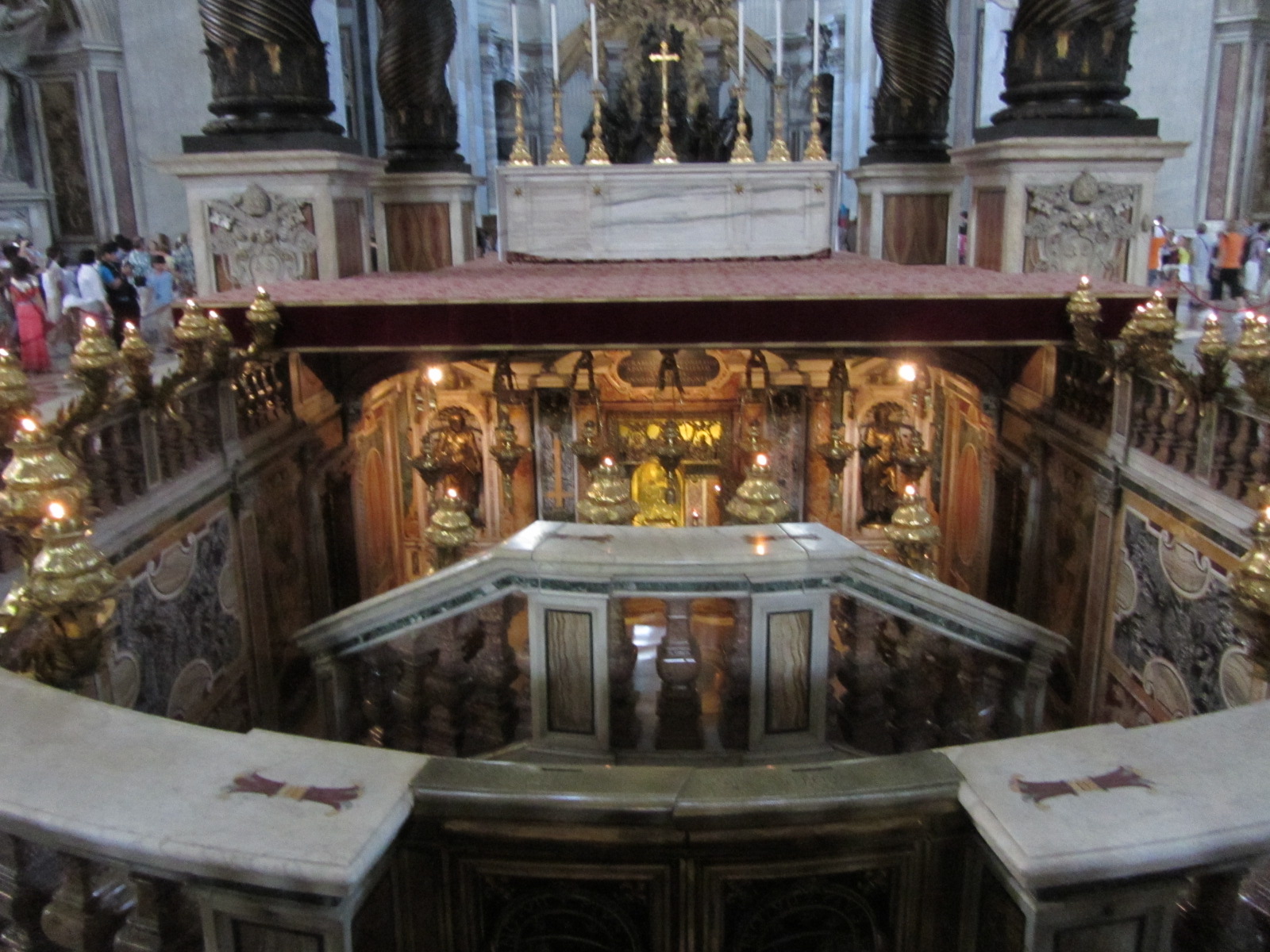
            In the center of the nave is the incredible Papal Altar, cast in bronze by Bernini. The Altar sits directly on top of the tomb of St. Peter, and is surrounded by four columns and reliquaries holding four incredibly important Christian artifacts. Believed to be in these reliquaries is the tip of the spear that St. Longinus used to pierce the crucified Christ, splinters of the True Cross, the veil of St. Veronica used to wipe sweat from his face, and the head of St. Andrew. It was pretty incredible to take a step back and think that I was standing at the center of all of Christianity—arguably the most important site in one of the world’s major religions!

The Statue of St. Peter:


            In front of the Papal Altar, to the east, is the famous bronze sculpture of St. Peter. It is said that visitors will have their prayers answered if they rub the right foot of St. Peter, and it shows. After millions of visitors through countless years have participated in this tradition, the foot of St. Peter is merely a polished stub from the oils on human hands eroding the bronze!

The Throne of St. Peter:


            On the west side of the Papal Altar is the brilliant throne of St. Peter. In the center of the throne is an enormous stained glass window depicting the Holy Spirit in a usual form, as a white dove. The Holy Spirit overlooks the entire sanctuary and has a wingspan of over six meters! From the other end of the basilica, you can barely even make out that it is a bird. St. Peter’s Basilica is an incredible display of scale and the ability to capture visitors’ eyes from certain distances. None is a better example than the Holy Spirit window or Michelangelo’s dome on top of the church. While he did not paint or decorate the inside of the dome, nor was he alive to see its completion, it remains one of his greatest architectural creations.

Bernini's Sculpture of St. Longinus:


            We continued our tour around the south wall of the basilica, passing more papal tombs, reliquaries, artwork, and memorials. I do not mean to downplay the significance of each and every work of art, plaque, engraving, and memorial, however to explain each and every one would take a very long time and a lot of space on this blog! Just before exiting the basilica we got to look inside the private Chapel of the Choir where many weddings are held and the massive diamond decorations above the depiction of Mary on the Altar of the Immaculate Conception. What an incredible place!

The Apostolic Palace and the Papal Apartments:


            Max and I thanked our awesome tour guide and also signed up for another Vatican tour for a few hours later, the tour of the adjacent Vatican Museums and the famed Sistine Chapel. We had some time to kill, so we went back inside the basilica to enjoy it on our own pace. I also used this time to reflect and say a prayer inside the Blessed Sacrament Chapel before we decided to leave for some lunch. We stopped at a nearby tourist café called Café San Pietro and grabbed some Salad and Tortellini before heading back to St. Peter’s Square to meet our new tour guide and walk up to the museums.

The Halls of the Vatican  Museums and the Dome of St. Peter's Basilica:


            Our new tour guide was a little more difficult to understand, however it was manageable, and he led us in, out, and back inside of the Vatican City limits up to the Vatican Museums. Once inside, he gave us an introduction and a lot of information about the Sistine Chapel, as visitors are not allowed to talk inside the chapel itself. We continued the tour inside and were immediately greeted with the Ancient Greek and Ancient Roman artifacts and sculptures that have been amassed by Popes and the Vatican over centuries. Each room was filled with hundreds of priceless artifacts—too many to even talk about for the tour guide, as one could spend weeks inside these museums and still barely scratch the surface of its volumes.

The Bronze Sculpture of Hercules in the Sala Rotonda:


            The Sala Rotonda is the first of the major rooms of the Vatican Museums, filled with Roman sculptures of great emperors, heroes, and gods. Multiple depictions of the great Hercules exist in this room, as well as extremely highly detailed mosaics of great Roman battles. It is almost a bit of a shame that we had to move so quickly through this museum, as I really could have spent a whole day admiring each work or artifact.

A Raphael Cartoon:


The Hall of Maps:


            We continued into the hall of Raphael cartoons—a hall filled with massive woven tapestries created by Raphael’s followers in his studio following his sketches. The next hallway was known as the Hall of Maps, as it is filled with enormous old topographic maps of the different parts of Italy through different eras in history. The ceiling of that room was equally awesome as it was filled with hundreds of extremely colorful small paintings and lavish decorations. Again, I could talk for days about each of these rooms, but I will save each and every detail for everyone’s future trip here!

The Ceiling of the Sistine Chapel (Sneaky...):


Michelangelo's Last Judgment (Note the Sneakiness):


            Finally, at the very end of the tour, we reached the Sistine Chapel. I thought I was in awe when I entered St. Peter’s Basilica—I was not ready for the sight that hit my eyes. I have never, and will never, see anything more beautiful in my life. It sounds cliché, but Michelangelo’s Sistine Chapel ceiling and his Last Judgment are probably the two most famous works of art, most absolutely incredible works of art, and the closest thing to perfection the world of art has reached to-date. My neck hurt from staring without moving at the ceiling for so long! The color restoration efforts that were completed in the last few years really did wonders to transform the artwork back into the splendid shades it was meant to be seen with. Visitors are not allowed to talk in there, nor take pictures, but Museum officials pace the room silencing those who do speak up and kicking people out who try to sneak pictures. After about a half hour or more of admiring the brilliance and peak of Renaissance art, I did manage to sneak a couple of my own before Max and I headed back into the museum to view some unguided sections before we decided we were too tired to continue. We were also told of the room adjacent to the Sistine Chapel, the Paulina Chapel, which was also lavishly painted and decorated by Michelangelo. Our tour guide showed us a keyhole where we could look into this extremely private room, however it was tough to see and short lived as a Swiss Guard discovered our plot and covered up the hole!

Max and I Atop the Dome of St. Peter's Basilica:


            The Vatican is one of the most ridiculously humbling and outstanding places I have visited on the face of the planet. But a warning to those who do go visit: it will be a very long, very tiring day, but one that you will never regret; just be prepared. Max and I took our remaining strength to climb to the top of Michelangelo’s dome to take in the views it affords as the tallest building in Rome. It is a brutally long and strenuous climb, but it is extremely worth it and gratifying to reach the top. After climbing back down, we hopped in a cab and headed back to our hostel for a much needed nap before dinner. We did not get to see the famous Raphael rooms in the Vatican Museums, but I suppose I must leave something to come back for!

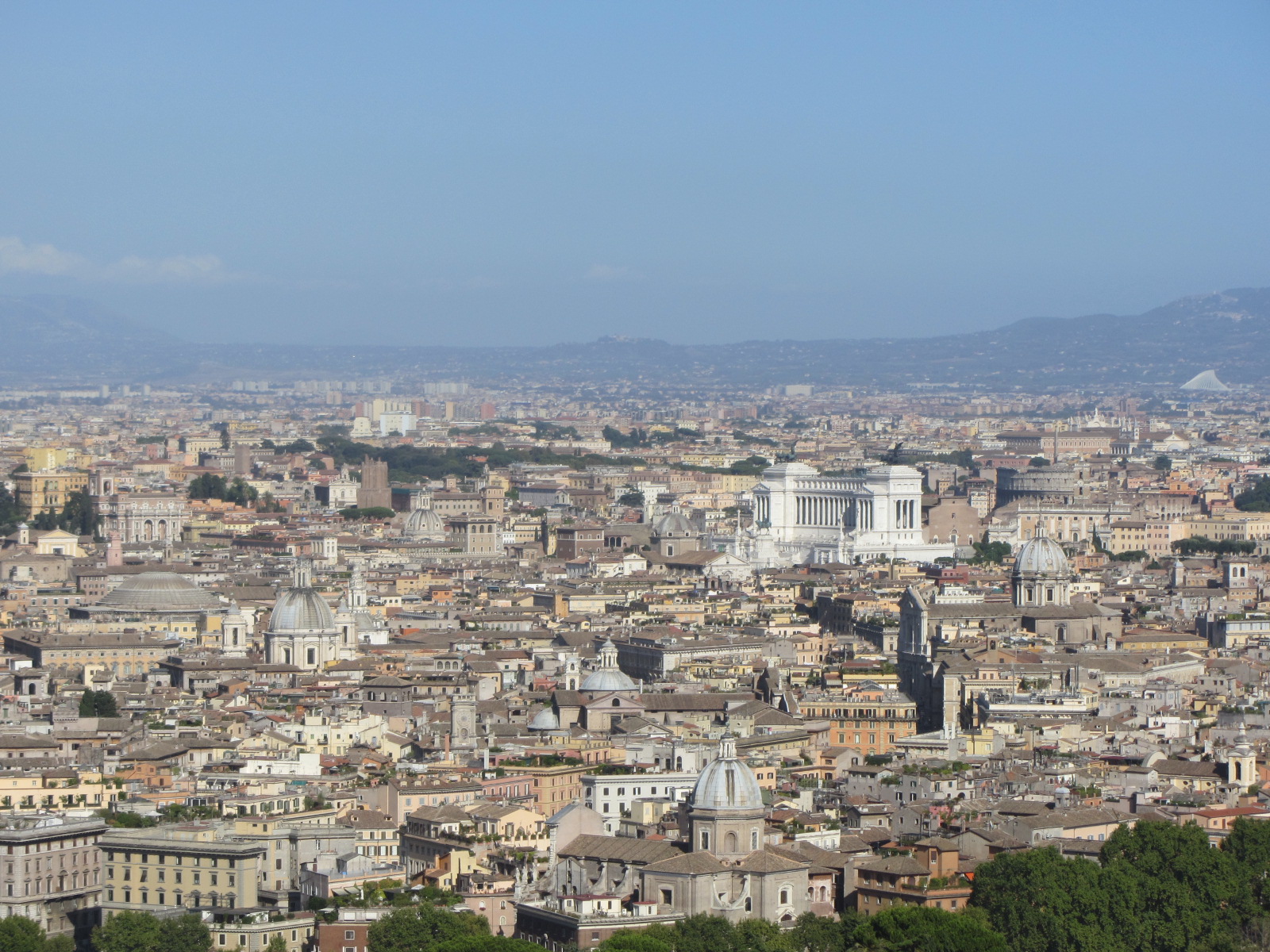
Rome from Atop St. Peter's Basilica:


            We ventured back out after a few hours of sleep to find some dinner at a place called Numbs, again fairly close to the Spanish Steps. Here I enjoyed some Bruschetta, Fusilli with Pesto, Beef strips with zuchini and tomatoes, and some Nastro Azzurro beer. Max and I enjoyed some post dinner cappuccinos while taking in the ambiance of Rome, complete with an accordion player and all! Following dinner, we walked back to the area near our hostel and found a fun bar called The Yellow where we met a bunch of kids our age from Australia, the US, and various countries around central Europe. We also met a nice guy named Drew Morgan who knew a friend of mine from high school—small world, as always. We hung out here for the majority of the night, enjoying conversations with our new friends and the US Military Veteran bartender before getting some shuteye after the longest but most incredible day of our great journey. And to think: No run-ins with the Swiss Guard!

A Swiss Guard:


Saturday, April 7, 2012

Italy: Day II (Rome)

Wednesday, July 20th:

St. Peter's Basilica, and the massive expanse of Rome from Pincio Park:


            Wow. Rome truly is one of the most beautiful places on earth. Never have I seen such a place where civilization has just kept building and building right on top of itself to the point where a building only five years old can be standing next to one that is two thousand years old! Max and I slept in this morning and I headed out by myself to explore the city as Max was feeling a bit under the weather. This time I decided to walk to the north of our hostel, instead of west towards the center of Ancient Rome. On my way I grabbed a couple of pizza slices right next to the Trevi Fountain, which looks quite different but still beautiful by day as opposed to by night.

The Spanish Steps:


            I continued to walk north and up a massive hill to the famed Spanish steps. The roses that normally line the steps in the spring were not there, but the steps are still quite a cool site, even if it is swarmed with tourists and people peddling useless toys, wares, and fake designer accessories. After exploring that area for a bit, I continued passed the Villa Medici and into the massive Villa Borghese park (also known as Pincio Park). This park serves as Rome’s version of New York City’s Central Park, complete with roads, tunnels, and vast fields to sunbath and get some exercise. I walked through the park for a long while until I came upon the Galleria Borghese museum. I had heard that it was one of the tougher tickets to get in Rome as the amount of visitors inside for a given time slot are limited, so I went inside to try and reserve a time slot for later in the week. I was delighted and surprised to be told that they had an opening for one person for the current time slot, so I hurried right inside.

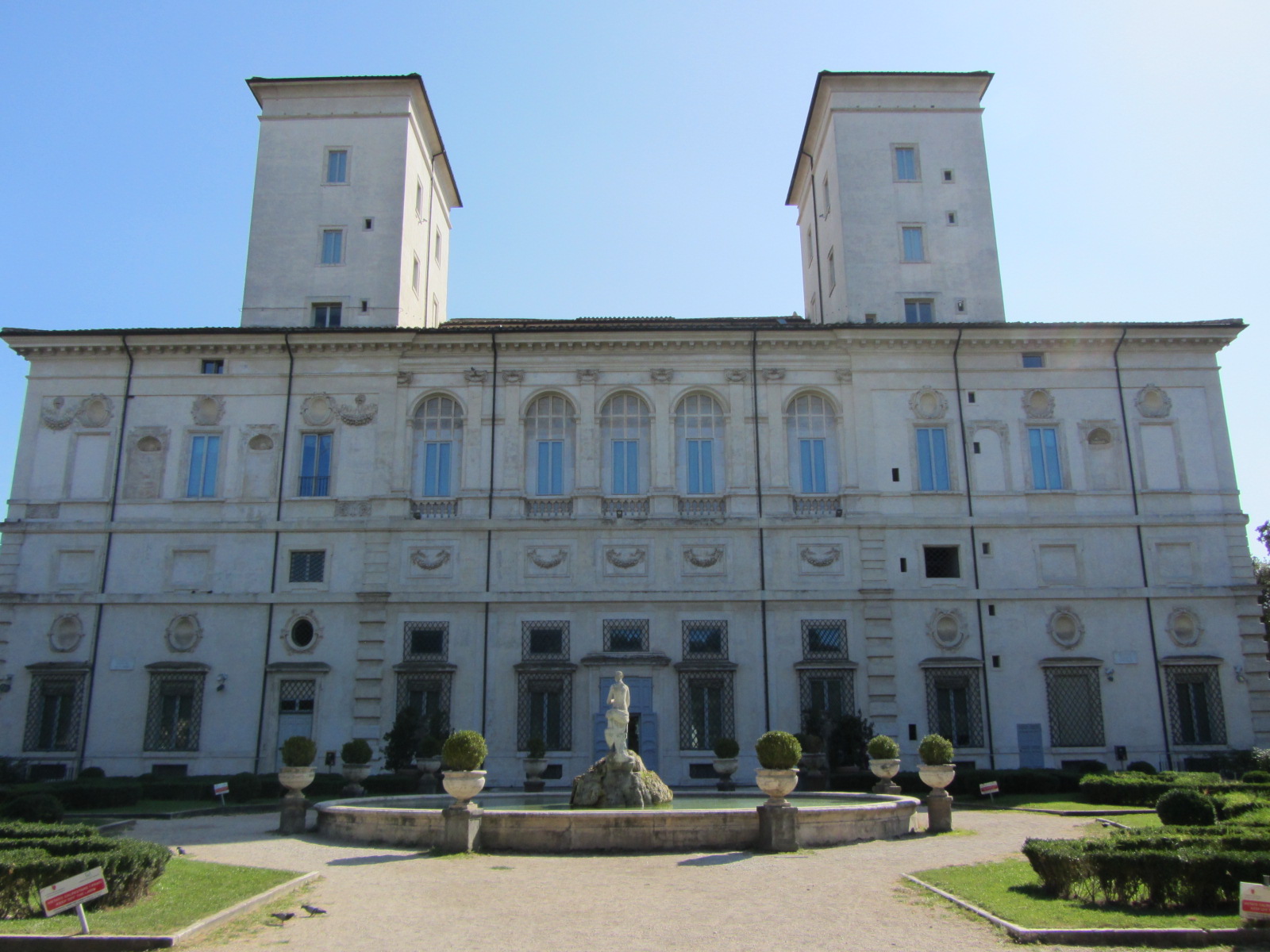
The Galleria Borghese:


            The Galleria Borghese is the most magnificent museum I have ever been inside. It is not very expansive, nor is it filled to the brim with artifacts, but it is set up in such a perfect manner of exclusivity, neatness, and beauty. The museum itself is actually the castle-like mansion of the Borghese family and the art is of the family’s personal collection, offering viewers the chance to see famous works in the spaces they were originally designed for. Each room on the first floor offers a ceiling covered in frescoes, marble and mosaic art floors, and a marble sculpture in the middle of the large expanse. The Borghese family was a major fan and patron of the sculptor Bernini, and five of his most famous works are in the family’s collection on display in their gallery. My favorite of them was the extremely detailed sculpture of Apollo and Daphne as she turns into a tree to avoid Apollo’s lust and love for her. The upstairs of the gallery contains rooms full of paintings, mostly from the Italian Renaissance. Famous artists on display include Caravaggio, Titian, Raphael, and Rubens.

Piazza del Popolo:


            Upon leaving the Borghese museum, I met up with Max and walked down the Spanish steps to Piazza del Popolo. Here we took in the bustling Roman atmosphere in one of the city’s busiest squares while drinking a couple Peronis and reading the news. We talked to some locals and even got to watch as a scene from an Italian movie was being filmed in the square. We waited until dark, grabbed a cappuccino, and walked back towards the Spanish Steps for dinner. The stores in the area around the steps are very high fashion, but we were able to find an amazing affordable restaurant called Il Gabriello. It was much like the restaurant from the first night, deep in a cool basement filled with Enoteca décor. I enjoyed a feast of Proscuitto, Risotto with Prawns, Veal in a white wine sauce, and a vanilla gelato truffle for dessert. We both washed down our meals with a bottle of Pinot Grigio from the Venezia region of Italy.

The Italian Flag at Night Atop the Palazzo del Quirinale:


            We walked back to our hostel again through another area we had not been to before, the piazza in front of the Palazzo del Quirinale, where the Italian president resides. The palace was massive and very pretty at night, but also under necessary tight security with armed guards at all entrances. We wandered our way back to our hostel to get some early shut-eye for the very long day ahead. Tomorrow we will tackle the massive church, palace, holy site, and small country that are the Vatican City.

Friday, April 6, 2012

Italy: Day I (Rome)

Tuesday, July 19th:

Trajan's Column and Trajan's Forum:


            Today was our first breathtaking day in The Eternal City and the first day of our two weeks in Italy! We woke up early after a very long and hot night in Split, Croatia and were given a ride to the airport by the hostel owner who calls herself “Ladybird” for whatever reason. It was a pleasant hour-long drive and we hopped on our plane to Rome after a short delay and some airport food.
Ciao Italia!
            We got off the plane and took a train to the main train station, Roma Termini. We were delighted to find that our hostel was only a short walk from the train station and that it was the best hostel I had stayed at to date on the trip! The Alessandro Palace Hostel was very spacious, had air conditioners and refrigerators in the rooms, and each guest gets a free bottle of wine at check-in! We were very tired from the night before, but I was so excited to see Rome for the first time that we pushed through it and got off to sightseeing quickly.

Piazza Venezia:


            We decided to take a long walk through the city and head for the famed Colosseo, or Colosseum. The walk took much longer than we thought, as the city is absolutely massive, but literally every step in Rome is worth taking the time to look at what is around you. The architecture, the people, the food…it is all eye candy. We arrived at the Colosseum after a twenty minute or so walk. The building is just as stunning as I had always dreamed, and stands as such a magnificent reminder of Ancient Rome that stands above the rest. We decided that we wanted to walk around the inside later in our trip, so we continued on passed Trajan’s Market, Piazza Venezia and the monstrous new monument to Vittorio Emanuele II, and strolled down Via del Corso in the city center. Funny fact we learned on the way: Rome has a flourishing metro system, however it has met major problems as a station is being built at Piazza Venezia. The metro path underground must cross the center of what used to be Ancient Rome, and every time they dig another few feet, they find literally hundreds of Ancient Roman artifacts!

The Trevi Fountain at Night:


            By now we decided that we were significantly hungry and wanted to dig into the famed Roman cuisine. We wandered around for a little bit before settling on a place called Spaghetteria-Pizzeria L’archetto. We knew we had picked a winner as our waiter walked us inside to our table, way in an old stone basement covered in Enoteca décor. This was the first of what I believe I will continue to say is the “best meal of my life.” We started with Bruschetta Primadoro as well as another Brushetta with Black Olives and Mozzerella. For my entre, I ate traditional Spaghetti Bolognese with some red wine called Dolcetto D'Alba. Both of us had a Roman Cappuccino for dessert before we were stuffed and on our way. We walked from there to the Trevi Fountain, lit up in all its glory at night. The fountain was very crowded with tourists, but it certainly looks spectacular against the black night sky.
            After the fountain we decided to go find a bar to enjoy some beverages at towards the Pantheon. There was not much to see at the Pantheon at night, but we checked it out anyways on the way to Campo di Fiori, an area full of outdoor bars that was recommended to us by multiple friends who had visited Rome before. We ended up spending the good portion of the rest of the night drinking Peroni steins (one full liter!) with some other Americans at a bar called Sloppy Sam’s while sharing our stories. At around two in the morning we decided to wander home a full forty-minute walk, including getting lost, before crashing into bed, excited for the sightseeing to come.

The Pantheon at Night:


Wednesday, February 29, 2012

More Posts to Come!

I am sorry I have not been able to update this in a long while, but I will finish off my trip soon. It has been a busy couple of months, and I am working on getting back into the swing of things, so expect posts about Italy to come soon!

Monday, November 21, 2011

Croatia: Day IV (Split)

Monday, July 18th:

St. Dominius Cathedral in Diocletian's Palace:


            A very long, at times frustrating, but still fascinating day we had today. The day started with a long, four-hour drive from Dubrovnik to Split, Croatia. Along the way we passed a tiny strip of about twenty miles of coastline that belongs to the nation of Bosnia and Herzegovina. It was given to the country as concessions to the Bosnian war for transit and as a link to the sea. Both Max and I thought it was cool that we were in Bosnia, so we took pictures of ourselves there before continuing back into Croatia for the rest of the drive. One highlight of the drive was the Great Wall of Croatia, a mysterious medieval wall on one of the Dalmatian islands off the coast that resembles the wall of greater namesake in the far-east.

The Great Wall of Croatia:


            We did have one hilarious gaffe on our drive that provided further adventure. Since the country is still developing and building new highways our GPS device did not know some of the roads we were driving on existed. We followed signs to Split before we came to a dead-end at an unconstructed road. We decided to try it anyways and off-roaded for about a mile before finding the road again, only we were on the wrong side of a concrete barrier. Shortly after contemplating trying to move the barriers we had to backtrack across the construction site to find the way around. It is probably a good thing we did, because we discovered that there was a toll-highway we needed to get a ticket for on the other side. This highway was pretty awesome though, as it was five-lanes wide and had a speed limit of one hundred forty-five kilometers (roughly one hundred miles-per-hour)! We sped along to Split and arrived at the port city in no time after that.

Max in Neum, Bosnia and Herzegovina:


            We checked in to our hostel for the night, the Split Beach Hostel, and went straight to Bacvice Beach, named one of the top party beaches in Croatia. We got lunch here at this beach lined with clubs and restaurants. We sat next to the water and went swimming while enjoying some Leo Dicaprio Pizza (ham and mushrooms) at Pizzeria Karaka. We also drank some Karlovacko draught beer and hung out until we needed to return the car.

Bacvice Beach:


            The next adventure began when we had to find the dealer to return our rental car. We had arranged to drop off the car in Split but the rental shop was in a very difficult-to-reach location near the walled-in old city center of Split. After driving the wrong way down several one-way streets and me walking some of them on foot to get directions, we finally dropped the car off. This was not without issue, however, as someone had stolen one of our hubcaps. Fifty Euros later, we angrily left the rental car dealer to make our way to the old city.

The Old West Gate to Diocletian's Palace:


            The Old City of Split is basically the ruins of a giant Roman palace, Diocletian’s Palace. We walked around this area for a while, exploring People’s Square, St. Dominius Cathedral, the Temple of Jupiter, and the basement halls of Diocletian’s Palace. We also climbed to the top of the bell tower of St. Dominius Cathedral to see the views of the port and the surrounding mountains that it offered. The area is very small but very charming and offers a glimpse into the Roman lifestyle that we will soon experience in Rome, Italy! We walked around the adjacent markets before heading back to Bacvice beach for another swim and more Karlovacko. We hung out there before getting dinner at the same restaurant as before, Pizzeria Karaka. This time I had a Captain Nemo salad with bacon and squid.

Ruins of the East Gate of Diocletian's Palace:


            We hung out at the beach for a while and explored the scene before heading back fairly early for some rest. This hostel was one of the most uncomfortable of the trip because there was no air conditioning and there was barely even a window offering a light breeze in the 80+ degree heat! We also had some problems with obnoxious Danish neighbors who kept us up half the night before our very early morning flight to Rome, Italy. It didn’t help also that there was no toilet paper, no hot water, and only one bed for the two of us. Hopefully our sleeping situations will improve when we get to Italy! Croatia is a beautiful country with some great things to do and see, and I would love to return here in the future to see how quickly it is developing and improving its amenities.

Zbogom Croatia!

Thursday, November 3, 2011

Croatia: Day III (Dubrovnik) - Montenegro: Day I (Kotor, Budva, Lovćen National Park)

Sunday, July 17th:

St. George's Island at Perast, Montenegro


            Today Max and I woke up and said goodbye to Chris before we rented a Volkswagen Passat for our drive down to Montenegro for the day. We drove down to the Old City of Dubrovnik first to do the hour-long walk around the city walls. This was one of the most beautiful days of my entire trip so far, but also the hottest as it was over 100 degrees Fahrenheit! The walk around the city walls was really awesome, but we hurried through it a little bit because we wanted to get down to Montenegro. There was a ton of traffic at the border and I had to offer up some extra money for agriculture taxes, but we were across the border in no time. The Balkan Mountains around us became more jagged and taller with each passing kilometer, and I stopped all the time to take pictures of the beauty.We also passed some scenic old cities such as Perast and Herceg Novi, but we did not stop for more than a picture.

St. Lawrence Fort from Atop Fort Minceta on the Dubrovnik City Walls:


            Max took a short nap while I drove around the Bay of Risan and the Bay of Kotor, and we arrived at the Old City of Kotor at around noon. This city is another medieval walled-in city of old, but it is smaller than Dubrovnik. It does not lack Dubrovnik’s beauty, however, because Kotor is tucked in the biggest fjord in Southern Europe, and is surrounded by tall mountains on each side. We walked around the city for a little while, exploring some of the small churches, before we stopped to have some lunch at a place called Scorpio Caffe. I went a little wild here and tried the Shark Medallions in Orange Sauce which was very good, and we also drank a local beer called Niksicko. After lunch we went inside a tiny church called St. Luca’s before we decided to climb the 1300+ steps up to St. John’s Fortress. The Fortress is over 850 feet above the city of Kotor and was built to protect it from invaders.

The Walls of Kotor:


            The climb was not very rigorous, but it sure felt pretty tough in the sweltering heat. We had to take a lot of water breaks, and thank God I brought my camelback backpack filled with water. We finished it by the top, but boy was the climb worth it. The top of St. John’s Fortress will stick in my mind forever as one of the most beautiful sights I have ever seen (and I had another that trumped it later in the day!). We descended slowly before we left Kotor to drive farther down the coast to another medieval walled-in city called Budva. The drive did not take very long, and we quickly noticed how much of a beach vacation destination Budva was. There were tents set up along all the beaches and the traffic was heavier for sure.

St. John's Fortress Above Kotor:


The View from the Top of St. John's Fortress:


            We drove passed Budva down the coast farther a ways before we found a tiny island connected by a small foot causeway called Sveti Stefan. This island has been turned into a resort, and it sure looks funny and cute jutting out into the Adriatic and covered with old Mediterranean buildings. We tried to walk out to the island but we were not allowed unless we were a resort guest, or we had restaurant reservations. We hopped back into the car and made the rather quick decision to drive way out of our way to Lovćen National Park. The drive to Lovćen was over an hour out of the way in both directions, but it was one of the most scenic drives of my life. Switchbacks climbed higher and higher up the mountains and breathtaking views of the coast, the Old City of Budva, and Sveti Stefan existed on every corner. We finally got over the first row of mountains before driving through the old capital of Montenegro, Cetinje. It was a pretty small city, and once again we were climbing, this time into Lovćen National Park.

Sveti Stefan:


Budva from the Climb to Cetinje:


            We got there very late in the day, and the weather was quite temperate on our drive up to Jezerski Mountain. The park information was closed, so we had to feel our way to the top, but I was on a mission. I had heard about a mausoleum that was built atop this National Park, and I was determined to find it. We passed multiple broken-down buses on our drive but we made it up just before the mausoleum was closing for visitors for the day. Thank God we came up here, because this trumps St. John’s Fortress as the most stunning sight my eyes had ever seen. The view at the top of Jezerski Mountain offers miles and miles of untouched mountains above the clouds in all directions. What a beautiful country Montenegro is! Max and I remained up here for a while and also went inside the Njegos Mausoleum to visit the bronze statues inside and the tomb of Njegos before heading back down. On the ride down we offered a ride to three backpackers who were planning to sleep up there but found out it was forbidden. The trio each hailed from one of Austria, Poland, and Spain, and were quite nice on our drive back down (which was much quicker than going up) to Budva.

The View Atop Jezerski Mountain in Lovćen National Park:


            We got to Budva famished for dinner, so we found the nearest parking spot on the main strip before looking for some food. Little did we know that our parking spot was a metered spot, but I will get to that soon. We walked through the Old City of Budva for a little while before settling on a place called Konoba Stari Grad right on the beach. I ate some absolutely wonderful Grilled Octopus here and Risotto with Sea Fruits while we both drank some local beer. The Octopus was served with head and all, and it became a favorite of my trip immediately! I don’t know what I would do without seafood in my life. After dinner we were thoroughly tired from our long day, and knew we had a long drive left, so we quickly walked by the Citadel of Budva before going to find our car.

The Budva Citadel at Night:


            When we got to our parking space, our car was missing. We looked around for a while before noticing a sign showing a tow-truck towing a car, so we went to find police to figure out the deal. The local policemen laughed at us, told us it would be two-hundred euro to get back, but then said it was merely twenty euro and that we had to only walk about a kilometer to retrieve the car from a nearby lot. We walked to the lot and an argument ensued between myself and the clerk, and it was only made worse by the language barrier. After asking a cop nearby if my two-hundred euro bill was counterfeit or not, he finally accepted it and we were on our way. The drive back home was fairly uneventful and quick, and both of us crashed in bed at around 2am. What an amazing, crazy, and awesome adventure! Tomorrow we are off to Split, a four hour drive to the North.

The Adriatic Coast at Budva and Sveti Stefan from the Climb to Cetinje: